Introduction: Why understanding the ground is non-negotiable
For any professional involved in underground construction, a comprehensive understanding of how the ground will behave is a fundamental prerequisite for safe and efficient design. The process of excavation fundamentally alters the natural state of equilibrium within a rock or soil mass, and predicting the ground’s reaction to this disturbance is the cornerstone of geotechnical engineering in tunnelling. This article provides a guide for early-career engineers on the core principles of ground behaviour. We will cover the formal definition of ground behaviour, the critical role of in-situ stresses, the process of stress redistribution caused by excavation, and the significant influence of groundwater.
Find more about the Ground support for tunnels in rock course.
For any professional involved in underground construction, a comprehensive understanding of how the ground will behave is a fundamental prerequisite for safe and efficient design. The process of excavation fundamentally alters the natural state of equilibrium within a rock or soil mass, and predicting the ground’s reaction to this disturbance is the cornerstone of geotechnical engineering in tunnelling. This article provides a guide for early-career engineers on the core principles of ground behaviour. We will cover the formal definition of ground behaviour, the critical role of in-situ stresses, the process of stress redistribution caused by excavation, and the significant influence of groundwater.
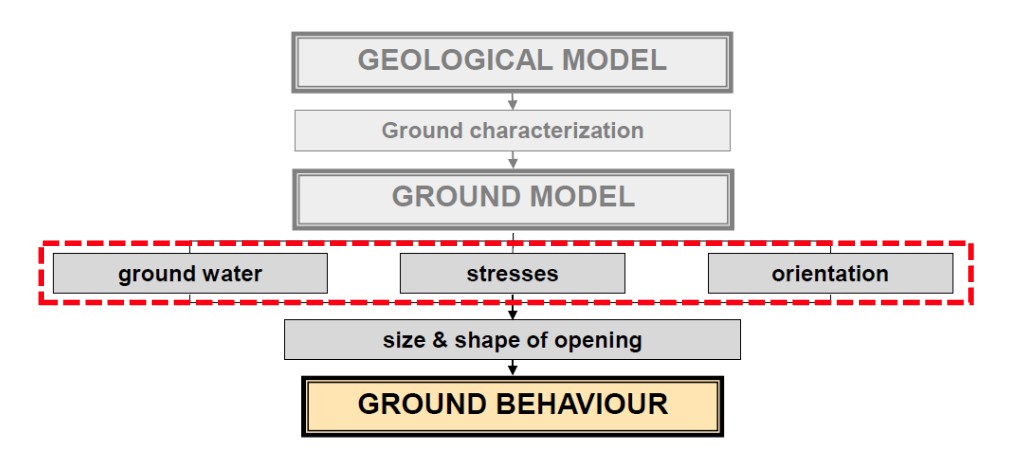
In the context of tunnelling, ground behaviour has a precise definition that is critical for hazard identification. It is formally defined as:
“The reaction of the ground to the excavation of the tunnel in its full profile without consideration of support or other construction measures = hazard identification”.
Essentially, it is the inherent response of the ground mass to the creation of an opening, before any support systems are installed. This behaviour is governed by a combination of geological and project-specific factors. The primary factors that determine ground behaviour include:
Before any excavation, a rock mass exists in a state of equilibrium under a field of “virgin” in-situ stresses. The vertical stress (σV) is typically a function of the overburden weight. However, it is a common condition in many geological settings for the horizontal stresses (σH, σh) to be significantly greater than the vertical stress.
This elevated horizontal stress is generally attributed to two primary components:
2.1. The lithostatic component (Poisson’s Effect)
This component arises from the confinement of the rock mass. As the weight of the overlying rock (vertical stress) causes vertical compression, the rock attempts to expand laterally. Since it is confined by the surrounding rock, this generates a horizontal stress component related to the material’s Poisson’s ratio.
2.2. The tectonic stress factor
This component is a result of induced strain from large-scale movements within the Earth’s crust. The magnitude of this tectonic stress is highly dependent on the deformation modulus, or stiffness, of the rock strata. This is because tectonic strain is applied over a vast area; stiffer rock units deform less and therefore accumulate and ‘lock in’ higher stresses, while more flexible units deform more easily and carry less of the tectonic load. Explain that stiffer layers of rock will carry more of the tectonic load, similar to how in a structure made of steel and rubber, the weight is carried by the stiffer steel.
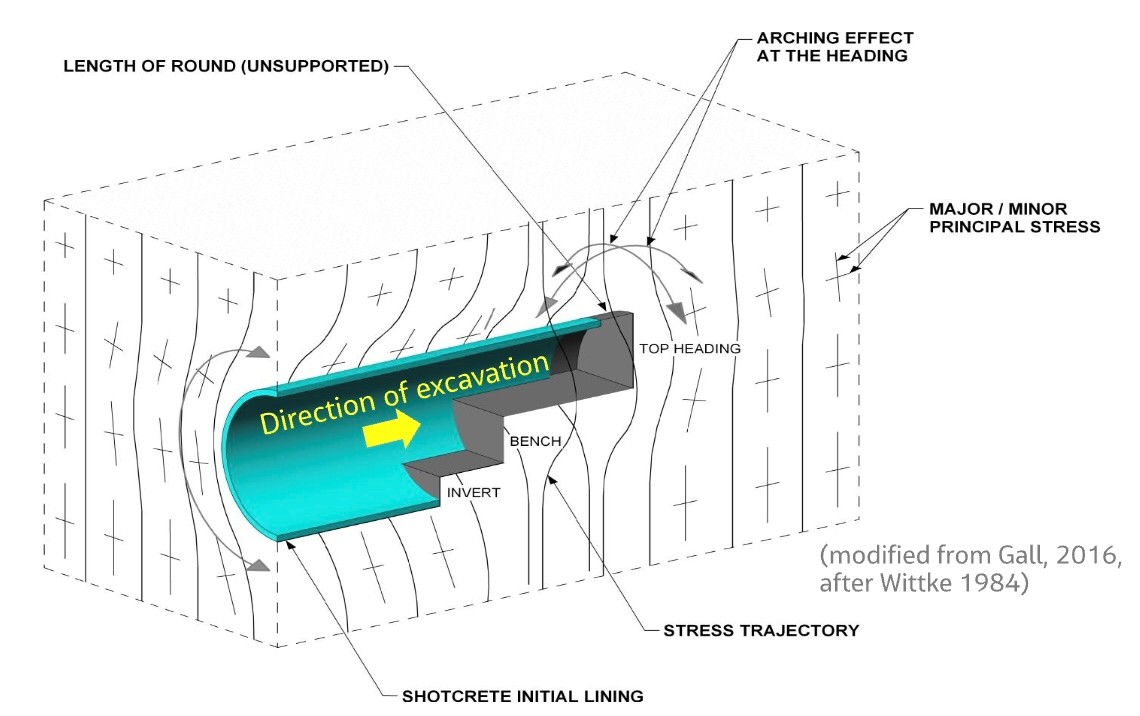
Having established the initial equilibrium of the virgin stress field, we must now consider the profound and immediate effects of excavation. The act of creating a tunnel is, by definition, an act of disturbing this equilibrium, forcing the pre-existing stresses to find new pathways through the rock mass. This change can be visualized as being similar to placing an obstacle in a water stream, forcing the flow to divert around it.
This stress redistribution has direct and significant consequences for the stability of the excavation.
This process of stress change does not occur instantaneously but happens gradually as the tunnel face advances. The area around the tunnel where these changes occur is known as the “Excavation Influence Zone” or “disturbed zone” (EDZ). For the purpose of support design, this three-dimensional behaviour is often simplified and represented using two common tools: the “Ground Reaction Curve” (GRC), which relates the internal support pressure to the inward displacement of the tunnel wall, and the “Longitudinal Displacement Profile” (LDP), which describes how ground displacement occurs gradually from ahead of the tunnel face to behind it. Together, they help engineers optimize the timing and stiffness of the support installation. These models are crucial engineering simplifications that allow us to translate the complex 3D stress changes around the tunnel face into a 2D problem, which is fundamental for calculating the required capacity and installation timing of support systems like rock bolts and shotcrete.
The stress concentrations and redistribution patterns discussed previously are not just theoretical concepts; they are the direct trigger for potential instability. When these newly concentrated stresses exceed the inherent strength of the rock mass, failure occurs. The type of failure is therefore a direct consequence of the stress field acting upon the ground’s geological characteristics. Failures can be broadly categorized as stress-driven, where the induced stresses exceed the rock mass strength, or gravity-driven, where pre-existing discontinuities control stability. Several common failure mechanisms can be anticipated based on ground conditions:
The presence of nearby excavations must be considered, as they can significantly alter the local in-situ stress field. A particularly important phenomenon is the creation of a “stress shadow,” where a large, pre-existing excavation can reduce the horizontal stresses acting on a subsequent, nearby tunnel.
In Section 2, we noted that high horizontal stresses can be beneficial. The ‘stress shadow’ phenomenon is critical because it can negate this benefit entirely. A tunnel expected to be in a stable, high-compression regime can suddenly find its roof in tension, a condition for which it may not be designed, dramatically increasing the risk of gravity-driven failure.
| Condition | K (H/V Stress Ratio) | Resulting Roof Stress |
| Virgin State | 2.0 | Clamping Effect (Compression) |
| Stress Shadow | 0.3 | Tensile Zone |
Similarly, twin tunnels create a stress shadow in the rock pillar that separates them. While this reduces horizontal stress in the pillar, it can concurrently increase vertical stresses, potentially altering the expected failure mode of the rock mass.
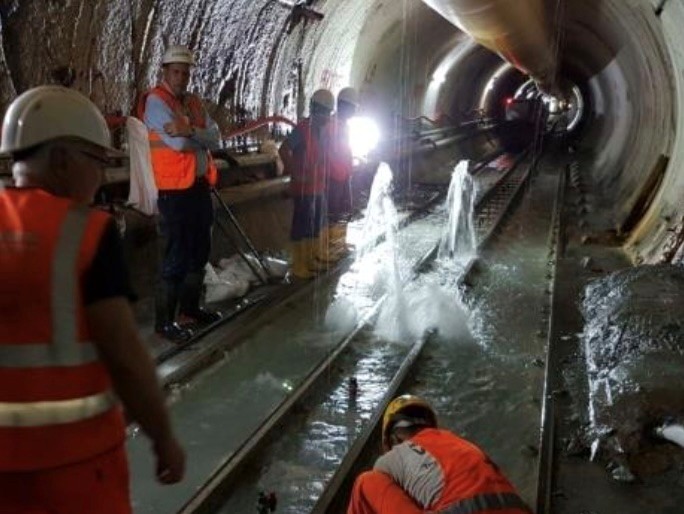
Groundwater is a critical factor that must be assessed due to its potential impact on both the surrounding environment and the structural integrity of the tunnel. Its two primary effects during construction are:
A thorough understanding of ground behaviour is not merely an academic exercise; it is the foundation of all sound tunnelling design. Predicting how a rock mass will respond to excavation requires an integrated analysis of the geological model, the virgin in-situ stress field, the influence of excavation geometry, and the effects of groundwater. By mastering these principles, engineers can effectively identify potential hazards, anticipate failure mechanisms, and design support systems that ensure the construction of safe, efficient, and durable underground structures.
An analysis of global geotechnical regulations and the critical role of instrumentation in construction safety.…
The application of Artificial Intelligence (AI) in civil engineering is transforming the way infrastructure is…
Here you can read a fragment of one of the "Finite element modelling in geotechnical…
Here you can read a fragment of one of the "Geostatistics for exploration and mining"…
Here you can read a fragment of one of the "Applied Biostratigraphy" course units, that…
Here you can read a fragment of one of the "Advanced Soil Mechanics" course units,…