
Advanced Site Response Analysis with PLAXIS 2D & 3D
Online course |
|
50 hours / 6 weeks |
|
|
Dates: September 7th to October 19th ¡ÚLTIMAS PLAZAS DISPONIBLES!
|
| Standard | Unemployed Or Student |
| $383 | $302 |
In colaboration with Bentley Systems

PLAXIS 2D & 3D license included
Introduction
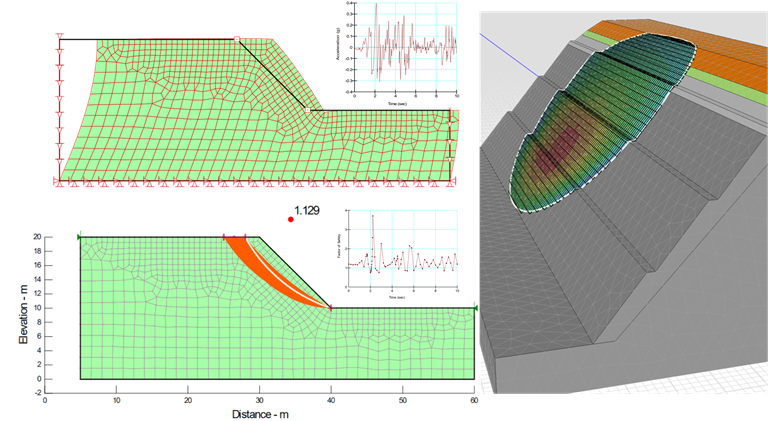
This course provides a focused and practical exploration of nonlinear site response analysis, equipping participants with the skills to model and interpret how local soil conditions transform incoming seismic waves.
The training covers the full site response workflow — from seismic hazard context and soil constitutive models, through nonlinear dynamic simulations in PLAXIS 2D, to 3D modelling of structural effects on site response. Participants will also gain valuable insights by comparing PLAXIS results with widely used tools such as EERA, SHAKE, NERA, and DEEPSOIL.
Using PLAXIS 2D and 3D with advanced constitutive models like HSsmall and UBC3D-PLM, the course blends theory with industry-ready practice, including real case studies and post-processing workflows.
By the end of the course, participants will be able
- Prepare site-specific models for dynamic ground motion analysis
- Apply realistic material behaviour for seismic loading
- Quantify amplification and deamplification effects in soil profiles
- Understand structural influences on site response in 3D
- Compare nonlinear finite element outputs with equivalent-linear and nonlinear 1D methods
This is a practical, example-driven course, ideal for engineers seeking to apply advanced site response techniques in real-world projects.
Limited places.
Module 1: Fundamentals of Site Response Analysis
- – Purpose and importance in geotechnical earthquake engineering
- – Overview of seismic hazard assessment
- – Types of site response analysis: equivalent-linear, nonlinear, and fully coupled approaches
- – Role of 1D, 2D, and 3D modelling
Module 2: PLAXIS 2D Fundamentals (Review)
- – Interface overview and essential workflows
- – Creating geometry and defining soil layers
- – Assigning material models and parameters
- – Boundaries, mesh generation, and phase setup
Module 3: Constitutive Models for Site Response Analysis
- – Soil behaviour under cyclic and seismic loading
- – HSsmall and UBC3D-PLM models
- – Selecting and calibrating model parameters for site response
Module 4: Site Response Analysis with PLAXIS 2D
- – Setting up dynamic soil column models
- – Applying base motions and defining dynamic boundaries
- – Running the analysis and interpreting surface and within-profile results
- – Industry examples with nonlinear dynamic modelling
Module 5: Site Response Analysis with PLAXIS 3D
- – Introduction to 3D modelling for site response
- – Demonstrating the effect of structural mass/stiffness on seismic response
- – Running and interpreting 3D results
- – Practical tips on computational efficiency
Module 6. Comparative Analysis of Methods
- – Comparing PLAXIS 2D, PLAXIS 3D, and NERA results
- – Overview of EERA, SHAKE, and DEEPSOIL formulations
- – Advantages and limitations for different project needs
Mostafa Ismail
Mostafa Ismail is a Chartered Professional Engineer with over 25 years of geotechnical experience across academia and industry.
He has led high-profile infrastructure and offshore projects, specialising in advanced numerical modelling, pile foundation design, and seismic analysis. His expertise includes vibration analysis and the automation of geotechnical simulations using PLAXIS 2D/3D and Python.
As a Technical Executive at WSP, Mostafa oversees large-scale projects, applying innovative solutions to complex geotechnical challenges and delivering resilient, high-performance designs under demanding conditions.
Throughout his career, Mostafa has worked across diverse environments, from onshore infrastructure to complex offshore developments.
Mostafa’s research contributions are internationally recognised. He has published extensively, served on the Editorial Board of the ASTM Geotechnical Testing Journal (GTJ), and was awarded the prestigious Hogentogler Award for the best paper in GTJ in 2006 during his tenure as an Associate Professor at the University of Western Australia.
In addition to his technical achievements, Mostafa is passionate about developing the next generation of engineers. He regularly conducts internal training programs and has designed several online courses to share his knowledge globally.
As a numerical lead at WSP, he continually innovates, creating new solutions to meet the technical demands of the evolving geotechnical industry.
The course is delivered online through our easy-to-use Virtual Campus platform. For this course, a variety of content is provided including:
– eLearning materials
– Videos
– Interactive multimedia content
– Live webinar classes
– Texts and technical articles
– Case studies
– Assignments and evaluation exercises
We regularly update this course to ensure the latest news and state-of-the-art developments are covered, and your knowledge of the subject is current.
Live webinars form part of our course delivery. These allow students and tutors to go through the course materials, exchange ideas and knowledge, and solve problems together in a virtual classroom setting. Students can also make use of the platform’s forum, a meeting point to interact with tutors and other students.
The tutoring system is managed by email. Students can email the tutor with any questions about the course and the tutor will be happy to help.
This course is designed for:
- – Geotechnical engineers, structural engineers, and infrastructure specialists involved in seismic analysis and design
- – Professionals seeking to expand from traditional equivalent-linear tools to advanced nonlinear FEM-based site response analysis
- – Engineers working on projects where soil–structure interaction and local site effects are critic
PREVIOUS KNOWLEDGE TAB
Participants should have:
- – A basic understanding of geotechnical engineering principles
- – Prior exposure to finite element analysis is helpful but not essential
- – No prior PLAXIS experience is required — fundamentals are included in the course
Once a student finishes the course and successfully completes the assignments and evaluation tests, they are sent an accreditation certificate. The certificate is issued by Ingeoexpert to verify that the student has passed the course. It is a digital certificate that is unique and tamper-proof – it is protected by Blockchain technology. This means it is possible for anyone to check that it is an authentic, original document.
You will be able to download the certificate in an electronic format from the Virtual Campus platform. The certificate can be forwarded by email, shared on social networks, and embedded on websites. To see an example, click here.
Completion of this course will enhance career opportunities in:
- – Geotechnical and structural engineering firms working in seismic regions
- – Infrastructure design projects requiring advanced seismic ground motion assessment
- – Consulting roles where nonlinear site response capability is a differentiator
In colaboration with Bentley Systems
PLAXIS 2D & 3D license included
Introduction
This course provides a focused and practical exploration of nonlinear site response analysis, equipping participants with the skills to model and interpret how local soil conditions transform incoming seismic waves.
The training covers the full site response workflow — from seismic hazard context and soil constitutive models, through nonlinear dynamic simulations in PLAXIS 2D, to 3D modelling of structural effects on site response. Participants will also gain valuable insights by comparing PLAXIS results with widely used tools such as EERA, SHAKE, NERA, and DEEPSOIL.
Using PLAXIS 2D and 3D with advanced constitutive models like HSsmall and UBC3D-PLM, the course blends theory with industry-ready practice, including real case studies and post-processing workflows.
By the end of the course, participants will be able
- Prepare site-specific models for dynamic ground motion analysis
- Apply realistic material behaviour for seismic loading
- Quantify amplification and deamplification effects in soil profiles
- Understand structural influences on site response in 3D
- Compare nonlinear finite element outputs with equivalent-linear and nonlinear 1D methods
This is a practical, example-driven course, ideal for engineers seeking to apply advanced site response techniques in real-world projects.
Limited places.
Module 1: Fundamentals of Site Response Analysis
- – Purpose and importance in geotechnical earthquake engineering
- – Overview of seismic hazard assessment
- – Types of site response analysis: equivalent-linear, nonlinear, and fully coupled approaches
- – Role of 1D, 2D, and 3D modelling
Module 2: PLAXIS 2D Fundamentals (Review)
- – Interface overview and essential workflows
- – Creating geometry and defining soil layers
- – Assigning material models and parameters
- – Boundaries, mesh generation, and phase setup
Module 3: Constitutive Models for Site Response Analysis
- – Soil behaviour under cyclic and seismic loading
- – HSsmall and UBC3D-PLM models
- – Selecting and calibrating model parameters for site response
Module 4: Site Response Analysis with PLAXIS 2D
- – Setting up dynamic soil column models
- – Applying base motions and defining dynamic boundaries
- – Running the analysis and interpreting surface and within-profile results
- – Industry examples with nonlinear dynamic modelling
Module 5: Site Response Analysis with PLAXIS 3D
- – Introduction to 3D modelling for site response
- – Demonstrating the effect of structural mass/stiffness on seismic response
- – Running and interpreting 3D results
- – Practical tips on computational efficiency
Module 6. Comparative Analysis of Methods
- – Comparing PLAXIS 2D, PLAXIS 3D, and NERA results
- – Overview of EERA, SHAKE, and DEEPSOIL formulations
- – Advantages and limitations for different project needs
Mostafa Ismail
Mostafa Ismail is a Chartered Professional Engineer with over 25 years of geotechnical experience across academia and industry.
He has led high-profile infrastructure and offshore projects, specialising in advanced numerical modelling, pile foundation design, and seismic analysis. His expertise includes vibration analysis and the automation of geotechnical simulations using PLAXIS 2D/3D and Python.
As a Technical Executive at WSP, Mostafa oversees large-scale projects, applying innovative solutions to complex geotechnical challenges and delivering resilient, high-performance designs under demanding conditions.
Throughout his career, Mostafa has worked across diverse environments, from onshore infrastructure to complex offshore developments.
Mostafa’s research contributions are internationally recognised. He has published extensively, served on the Editorial Board of the ASTM Geotechnical Testing Journal (GTJ), and was awarded the prestigious Hogentogler Award for the best paper in GTJ in 2006 during his tenure as an Associate Professor at the University of Western Australia.
In addition to his technical achievements, Mostafa is passionate about developing the next generation of engineers. He regularly conducts internal training programs and has designed several online courses to share his knowledge globally.
As a numerical lead at WSP, he continually innovates, creating new solutions to meet the technical demands of the evolving geotechnical industry.
The course is delivered online through our easy-to-use Virtual Campus platform. For this course, a variety of content is provided including:
– eLearning materials
– Videos
– Interactive multimedia content
– Live webinar classes
– Texts and technical articles
– Case studies
– Assignments and evaluation exercises
We regularly update this course to ensure the latest news and state-of-the-art developments are covered, and your knowledge of the subject is current.
Live webinars form part of our course delivery. These allow students and tutors to go through the course materials, exchange ideas and knowledge, and solve problems together in a virtual classroom setting. Students can also make use of the platform’s forum, a meeting point to interact with tutors and other students.
The tutoring system is managed by email. Students can email the tutor with any questions about the course and the tutor will be happy to help.
This course is designed for:
- – Geotechnical engineers, structural engineers, and infrastructure specialists involved in seismic analysis and design
- – Professionals seeking to expand from traditional equivalent-linear tools to advanced nonlinear FEM-based site response analysis
- – Engineers working on projects where soil–structure interaction and local site effects are critic
PREVIOUS KNOWLEDGE TAB
Participants should have:
- – A basic understanding of geotechnical engineering principles
- – Prior exposure to finite element analysis is helpful but not essential
- – No prior PLAXIS experience is required — fundamentals are included in the course
Once a student finishes the course and successfully completes the assignments and evaluation tests, they are sent an accreditation certificate. The certificate is issued by Ingeoexpert to verify that the student has passed the course. It is a digital certificate that is unique and tamper-proof – it is protected by Blockchain technology. This means it is possible for anyone to check that it is an authentic, original document.
You will be able to download the certificate in an electronic format from the Virtual Campus platform. The certificate can be forwarded by email, shared on social networks, and embedded on websites. To see an example, click here.
Completion of this course will enhance career opportunities in:
- – Geotechnical and structural engineering firms working in seismic regions
- – Infrastructure design projects requiring advanced seismic ground motion assessment
- – Consulting roles where nonlinear site response capability is a differentiator
3 reviews for Advanced Site Response Analysis with PLAXIS 2D & 3D
More info
Finish this course and get a certificate based on Blockchain
Advanced Site Response Analysis with PLAXIS 2D & 3D

Blockchain technology makes the certificate incorruptible, enabling companies to verifiy its autenticity.
Advanced Site Response Analysis with PLAXIS 2D & 3D
| $383 | $302 | |
| Get more information |
Meisam Goudarzy –
The course was perfect.
Alexandrin Dicu –
The “Advanced Site Response Analysis with PLAXIS 2D & 3D” course was beyond expectations, combining deep theoretical insights with practical modelling workflows. The Professor was extremely helpful, always responsive to questions, and provided clear guidance throughout the sessions. Each question was handled thoroughly and with clear expertise, which made the learning process focused and effective. I would highly recommend this course to anyone seeking advanced knowledge and practical skills in geotechnical earthquake engineering.
Upendra Modalavalasa –
The course was very informative and helped me clearly understand both 1D and advanced 2D site response analysis. The hands-on exercises with PLAXIS, useful for learning correct boundary conditions and nonlinear modelling. Overall, the course improved my confidence in performing and interpreting site response analysis