
AI-assisted PLAXIS 2D and 3D automation with Python
Online course |
|
50 hours / 6 weeks |
|
|
Dates: November 9th to December 21st |
| Standard | Unemployed Or Student |
| $452 | $360 |
In colaboration with Bentley Systems

PLAXIS 2D & 3D license included
Introduction
Engineering workflows are changing rapidly. Many geotechnical engineers and PLAXIS users regularly face repetitive and time-consuming tasks — extracting results, post-processing outputs, modifying parameters, rerunning sensitivity studies, or manually repeating similar workflows across multiple models.
While automation can dramatically improve efficiency, many engineers hesitate to adopt programming because it often feels intimidating, overly technical, or disconnected from everyday engineering practice.
This course has been specifically designed to bridge that gap.
AI-assisted PLAXIS 2D and 3D automation with Python is a practical, engineering-focused course that teaches participants how to build powerful PLAXIS automation workflows using Python and Artificial Intelligence — without needing to become programmers.
The course adopts a highly practical and progressive approach, combining:
- Ready-to-use engineering scripts that participants can apply immediately
- Reusable automation building blocks (“engineering mosaics”)
- Real workflows developed from practical geotechnical projects
- Structured collaboration with Artificial Intelligence to develop and adapt scripts
- Practical debugging and workflow validation strategies
Rather than teaching programming theory in isolation, the course focuses on solving real engineering problems efficiently.
Participants will progressively learn how to automate common and advanced PLAXIS tasks, including result extraction, post-processing, material modifications, repetitive workflows, reporting, and custom engineering automation.
The course philosophy is based on small, progressive wins.
Participants will quickly gain practical tools that can immediately improve productivity, while progressively building confidence to create and adapt their own automation workflows.
What makes this course different?
This course has been intentionally designed around the needs of busy engineering professionals.
Participants will benefit from:
-
- Immediate practical value through ready-to-use engineering scripts from Day One
- Small progressive wins designed to build confidence gradually
- Real engineering workflows developed from actual projects
- Reusable engineering mosaics that can be combined and adapted to suit different applications
- AI-assisted workflow development, helping participants extend beyond prebuilt scripts
- Low intimidation, high practicality, with no programming background required
Objectives
By the end of the course, participants will be able to:
- Use ready-to-run engineering scripts to solve practical PLAXIS problems
- Build reusable automation workflows using Python and PLAXIS scripting
- Extract and process engineering results efficiently
- Modify and automate repetitive numerical modelling tasks
- Collaborate effectively with Artificial Intelligence to develop and adapt workflows
- Build their own growing library of reusable engineering automation tools
This is a highly practical, example-driven course designed for engineers who want to work smarter, save time, and unlock the automation potential of PLAXIS — without needing to become software developers.
Previous knowledge tab
Participants should have:
- – A basic understanding of geotechnical engineering principles
- – Basic familiarity with PLAXIS 2D or PLAXIS 3D
- – No prior Python programming experience is required.
- – No prior coding background is necessary.
- – The course has been intentionally designed for engineers who wish to automate engineering workflows without becoming programmers.
Limited places.
Module 1 – Ready-to-Use Engineering Scripts
- – Practical engineering scripts ready for immediate use
- – Static and dynamic result extraction workflows
- – Settlement, pile force, displacement, and output automation
- – Productivity tools for reporting and post-processing
- – Real examples developed from engineering practice
Module 2 – The Modern PLAXIS Workflow
How This Actually Works
-
- * Why engineers traditionally struggle with automation
- * Introduction to AI-assisted engineering workflows
- * Engineering continuity and workflow thinking
- * The Mosaic Framework for reusable automation
- *The PLAXIS Intelligence Database concept
- – Setting up Python, VS Code, and scripting environments
Module 3 – Core Automation Mosaics
The Building Blocks
- – PLAXIS Input and Output communication
- – Interrogating models, phases, and materials
- – Material property modification
- – Phase handling and automation
- – Reusable scripting structures
- – Logging and debugging fundamentals
Module 4 – Output Extraction Mosaics
Extracting Engineering Intelligence
- – Extraction of pile, plate, and structural forces
- – Settlement and displacement extraction
- – Stress and strain outputs
- – Dynamic time-history extraction
- – CurvePoints and StressPoints
- – Automated reporting workflows
Module 5 – Working with AI Professionally
How to Build What You Want
- – Structured interaction with Artificial Intelligence
- – Feeding engineering mosaics into AI workflows
- – Constraining and refining AI-generated scripts
- – Debugging and validation of outputs
- – Building reliable engineering automation systems
Module 6 – Building a New Project from Scratch
Putting Everything Together
- – Building a real automation workflow from a new engineering problem
- – Structured collaboration with AI from concept to final script
- – Practical debugging and refinement
- – Demonstration using both PLAXIS 2D and PLAXIS 3D workflows
- – Strategies for building independent automation capability
Mostafa Ismail
Mostafa Ismail is a Chartered Professional Engineer with over 25 years of geotechnical experience across academia and industry.
He has led major infrastructure, offshore, and complex numerical modelling projects, specialising in advanced finite element modelling, automation workflows, pile foundation systems, seismic engineering, and geotechnical numerical analysis.
Throughout his career, Mostafa has extensively applied PLAXIS 2D and 3D to solve highly demanding engineering challenges and has developed numerous automation workflows using Python to improve efficiency, accuracy, and engineering productivity.
More recently, he has pioneered practical AI-assisted engineering workflows, integrating Artificial Intelligence into numerical modelling and automation to reduce programming barriers and accelerate engineering problem-solving.
As a Technical Executive at WSP, Mostafa continues to lead technically challenging projects while actively developing innovative solutions for the next generation of geotechnical engineering practice.
He is passionate about teaching practical engineering skills and regularly delivers professional training courses designed to bridge the gap between advanced engineering methods and real-world practice.
The course is delivered online through our easy-to-use Virtual Campus platform. For this course, a variety of content is provided including:
– eLearning materials
– Videos
– Interactive multimedia content
– Live webinar classes
– Texts and technical articles
– Case studies
– Assignments and evaluation exercises
Students can download the materials and work through the course at their own pace.
We regularly update this course to ensure the latest news and state-of-the-art developments are covered, and your knowledge of the subject is current.
Live webinars form part of our course delivery. These allow students and tutors to go through the course materials, exchange ideas and knowledge, and solve problems together in a virtual classroom setting. Students can also make use of the platform’s forum, a meeting point to interact with tutors and other students.
The tutoring system is managed by email. Students can email the tutor with any questions about the course and the tutor will be happy to help.
This course is designed for:
- – Geotechnical engineers using PLAXIS 2D or 3D
- – Practising engineers seeking to automate repetitive numerical modelling tasks
- – Researchers and postgraduate students working with PLAXIS
- – Engineers interested in improving workflow efficiency
- – Professionals interested in integrating AI into engineering practice
Once a student finishes the course and successfully completes the assignments and evaluation tests, they are sent an accreditation certificate. The certificate is issued by Ingeoexpert to verify that the student has passed the course. It is a digital certificate that is unique and tamper-proof – it is protected by Blockchain technology. This means it is possible for anyone to check that it is an authentic, original document.
You will be able to download the certificate in an electronic format from the Virtual Campus platform. The certificate can be forwarded by email, shared on social networks, and embedded on websites. To see an example, click here.
Automation and Artificial Intelligence are rapidly transforming engineering practice. Increasingly, organizations are seeking engineers who can combine strong technical expertise with efficient digital workflows.
The skills developed in this course will help participants improve productivity, reduce repetitive engineering tasks, and deliver more efficient numerical modelling workflows using PLAXIS, Python, and AI. These capabilities are valuable across a wide range of industries, including geotechnical consulting, infrastructure, mining, energy, transportation, research, and advanced numerical modelling, where automation and digital engineering are becoming key differentiators.
Rather than training software developers, this course empowers practicing engineers to become more efficient,
innovative, and competitive in modern engineering practice.
In colaboration with Bentley Systems
PLAXIS 2D & 3D license included
Introduction
Engineering workflows are changing rapidly. Many geotechnical engineers and PLAXIS users regularly face repetitive and time-consuming tasks — extracting results, post-processing outputs, modifying parameters, rerunning sensitivity studies, or manually repeating similar workflows across multiple models.
While automation can dramatically improve efficiency, many engineers hesitate to adopt programming because it often feels intimidating, overly technical, or disconnected from everyday engineering practice.
This course has been specifically designed to bridge that gap.
AI-assisted PLAXIS 2D and 3D automation with Python is a practical, engineering-focused course that teaches participants how to build powerful PLAXIS automation workflows using Python and Artificial Intelligence — without needing to become programmers.
The course adopts a highly practical and progressive approach, combining:
- Ready-to-use engineering scripts that participants can apply immediately
- Reusable automation building blocks (“engineering mosaics”)
- Real workflows developed from practical geotechnical projects
- Structured collaboration with Artificial Intelligence to develop and adapt scripts
- Practical debugging and workflow validation strategies
Rather than teaching programming theory in isolation, the course focuses on solving real engineering problems efficiently.
Participants will progressively learn how to automate common and advanced PLAXIS tasks, including result extraction, post-processing, material modifications, repetitive workflows, reporting, and custom engineering automation.
The course philosophy is based on small, progressive wins.
Participants will quickly gain practical tools that can immediately improve productivity, while progressively building confidence to create and adapt their own automation workflows.
What makes this course different?
This course has been intentionally designed around the needs of busy engineering professionals.
Participants will benefit from:
-
- Immediate practical value through ready-to-use engineering scripts from Day One
- Small progressive wins designed to build confidence gradually
- Real engineering workflows developed from actual projects
- Reusable engineering mosaics that can be combined and adapted to suit different applications
- AI-assisted workflow development, helping participants extend beyond prebuilt scripts
- Low intimidation, high practicality, with no programming background required
Objectives
By the end of the course, participants will be able to:
- Use ready-to-run engineering scripts to solve practical PLAXIS problems
- Build reusable automation workflows using Python and PLAXIS scripting
- Extract and process engineering results efficiently
- Modify and automate repetitive numerical modelling tasks
- Collaborate effectively with Artificial Intelligence to develop and adapt workflows
- Build their own growing library of reusable engineering automation tools
This is a highly practical, example-driven course designed for engineers who want to work smarter, save time, and unlock the automation potential of PLAXIS — without needing to become software developers.
Previous knowledge tab
Participants should have:
- – A basic understanding of geotechnical engineering principles
- – Basic familiarity with PLAXIS 2D or PLAXIS 3D
- – No prior Python programming experience is required.
- – No prior coding background is necessary.
- – The course has been intentionally designed for engineers who wish to automate engineering workflows without becoming programmers.
Limited places.
Module 1 – Ready-to-Use Engineering Scripts
- – Practical engineering scripts ready for immediate use
- – Static and dynamic result extraction workflows
- – Settlement, pile force, displacement, and output automation
- – Productivity tools for reporting and post-processing
- – Real examples developed from engineering practice
Module 2 – The Modern PLAXIS Workflow
How This Actually Works
-
- * Why engineers traditionally struggle with automation
- * Introduction to AI-assisted engineering workflows
- * Engineering continuity and workflow thinking
- * The Mosaic Framework for reusable automation
- *The PLAXIS Intelligence Database concept
- – Setting up Python, VS Code, and scripting environments
Module 3 – Core Automation Mosaics
The Building Blocks
- – PLAXIS Input and Output communication
- – Interrogating models, phases, and materials
- – Material property modification
- – Phase handling and automation
- – Reusable scripting structures
- – Logging and debugging fundamentals
Module 4 – Output Extraction Mosaics
Extracting Engineering Intelligence
- – Extraction of pile, plate, and structural forces
- – Settlement and displacement extraction
- – Stress and strain outputs
- – Dynamic time-history extraction
- – CurvePoints and StressPoints
- – Automated reporting workflows
Module 5 – Working with AI Professionally
How to Build What You Want
- – Structured interaction with Artificial Intelligence
- – Feeding engineering mosaics into AI workflows
- – Constraining and refining AI-generated scripts
- – Debugging and validation of outputs
- – Building reliable engineering automation systems
Module 6 – Building a New Project from Scratch
Putting Everything Together
- – Building a real automation workflow from a new engineering problem
- – Structured collaboration with AI from concept to final script
- – Practical debugging and refinement
- – Demonstration using both PLAXIS 2D and PLAXIS 3D workflows
- – Strategies for building independent automation capability
Mostafa Ismail
Mostafa Ismail is a Chartered Professional Engineer with over 25 years of geotechnical experience across academia and industry.
He has led major infrastructure, offshore, and complex numerical modelling projects, specialising in advanced finite element modelling, automation workflows, pile foundation systems, seismic engineering, and geotechnical numerical analysis.
Throughout his career, Mostafa has extensively applied PLAXIS 2D and 3D to solve highly demanding engineering challenges and has developed numerous automation workflows using Python to improve efficiency, accuracy, and engineering productivity.
More recently, he has pioneered practical AI-assisted engineering workflows, integrating Artificial Intelligence into numerical modelling and automation to reduce programming barriers and accelerate engineering problem-solving.
As a Technical Executive at WSP, Mostafa continues to lead technically challenging projects while actively developing innovative solutions for the next generation of geotechnical engineering practice.
He is passionate about teaching practical engineering skills and regularly delivers professional training courses designed to bridge the gap between advanced engineering methods and real-world practice.
The course is delivered online through our easy-to-use Virtual Campus platform. For this course, a variety of content is provided including:
– eLearning materials
– Videos
– Interactive multimedia content
– Live webinar classes
– Texts and technical articles
– Case studies
– Assignments and evaluation exercises
Students can download the materials and work through the course at their own pace.
We regularly update this course to ensure the latest news and state-of-the-art developments are covered, and your knowledge of the subject is current.
Live webinars form part of our course delivery. These allow students and tutors to go through the course materials, exchange ideas and knowledge, and solve problems together in a virtual classroom setting. Students can also make use of the platform’s forum, a meeting point to interact with tutors and other students.
The tutoring system is managed by email. Students can email the tutor with any questions about the course and the tutor will be happy to help.
This course is designed for:
- – Geotechnical engineers using PLAXIS 2D or 3D
- – Practising engineers seeking to automate repetitive numerical modelling tasks
- – Researchers and postgraduate students working with PLAXIS
- – Engineers interested in improving workflow efficiency
- – Professionals interested in integrating AI into engineering practice
Once a student finishes the course and successfully completes the assignments and evaluation tests, they are sent an accreditation certificate. The certificate is issued by Ingeoexpert to verify that the student has passed the course. It is a digital certificate that is unique and tamper-proof – it is protected by Blockchain technology. This means it is possible for anyone to check that it is an authentic, original document.
You will be able to download the certificate in an electronic format from the Virtual Campus platform. The certificate can be forwarded by email, shared on social networks, and embedded on websites. To see an example, click here.
Automation and Artificial Intelligence are rapidly transforming engineering practice. Increasingly, organizations are seeking engineers who can combine strong technical expertise with efficient digital workflows.
The skills developed in this course will help participants improve productivity, reduce repetitive engineering tasks, and deliver more efficient numerical modelling workflows using PLAXIS, Python, and AI. These capabilities are valuable across a wide range of industries, including geotechnical consulting, infrastructure, mining, energy, transportation, research, and advanced numerical modelling, where automation and digital engineering are becoming key differentiators.
Rather than training software developers, this course empowers practicing engineers to become more efficient,
innovative, and competitive in modern engineering practice.
More info
Finish this course and get a certificate based on Blockchain
AI-assisted PLAXIS 2D and 3D automation with Python
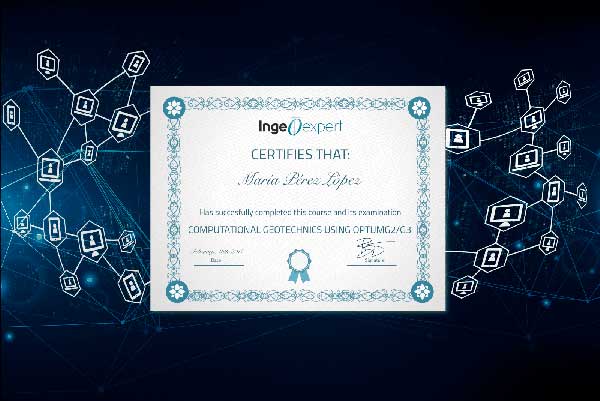
Blockchain technology makes the certificate incorruptible, enabling companies to verifiy its autenticity.
AI-assisted PLAXIS 2D and 3D automation with Python
| $452 | $360 | |
| Get more information |
Reviews
There are no reviews yet.