

AI applications in waste heat recovery and renewable energy
Online course |
|
50 hours / 10 weeks |
|
To be determined |
Introduction
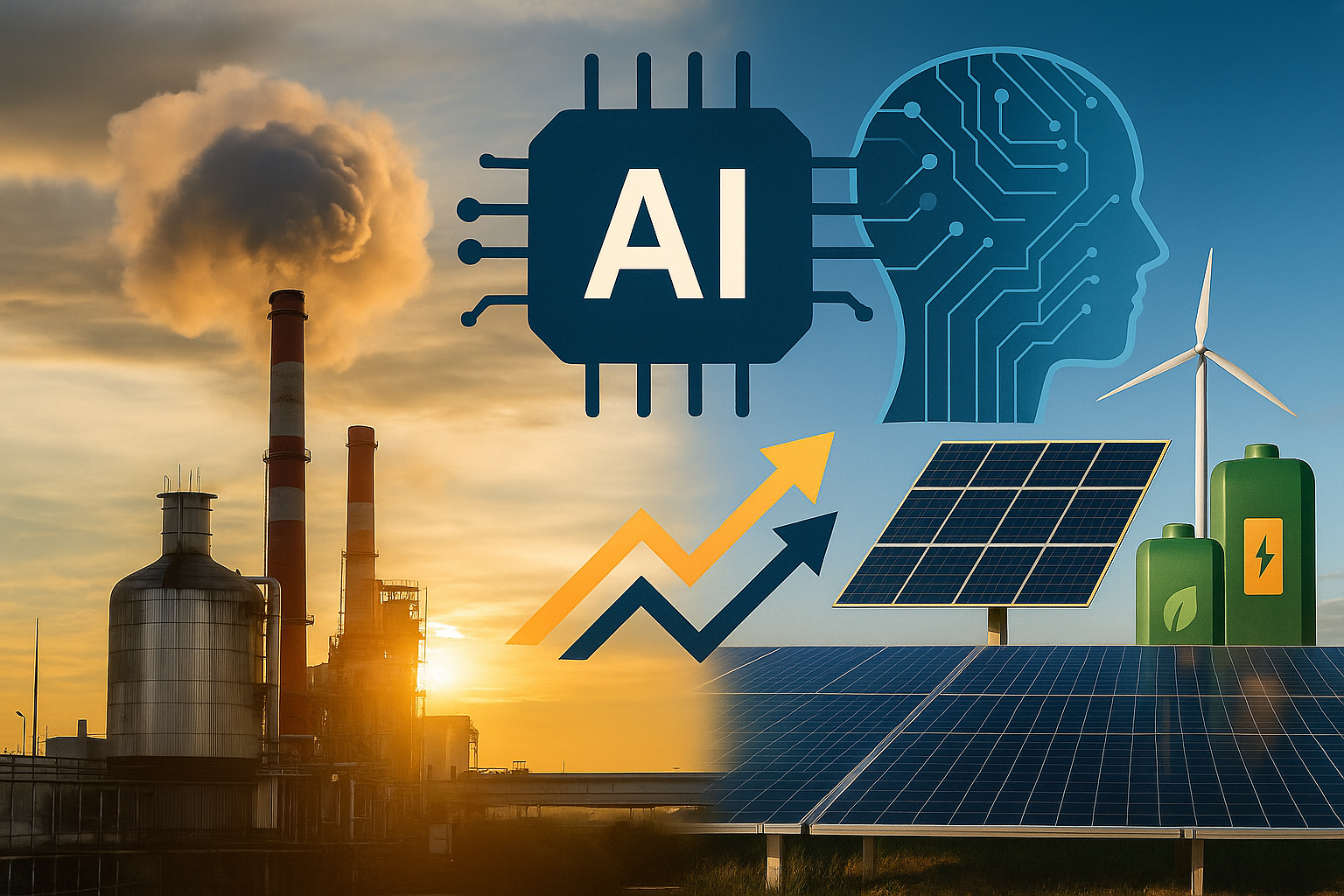
Using AI in waste heat recovery and renewable energy provides significant advantages by improving system efficiency, reducing operational costs, and enabling smarter energy management. AI is increasingly used to optimize energy systems, predict performance, automate control, and enhance efficiency in waste heat recovery and renewables. As industries decarbonize, the demand for intelligent energy solutions is rising sharply.
Objectives
Waste heat recovery (WHR) involves capturing unused heat from industrial processes or engines and reusing it. AI enhances this process in several ways: Optimization of heat recovery fault detection, predictive maintenance, and system integration.
AI in renewable energy systems: renewable energy systems like solar PV, wind, and biomass are inherently variable. AI helps manage this complexity: forecasting and load prediction, performance monitoring, and diagnostics, and energy storage and sispatch optimization.
Limited places.
Week 1: introduction to AI in energy systems
- – Definitions: AI, ML, deep learning
- – AI in industrial and energy systems
- – Types of AI techniques: supervised, unsupervised, reinforcement learning
- – Case studies in renewable energy
- – Lab: exploring energy datasets and preprocessing in Python
Week 2: waste-to-power technologies
- – Overview of waste management streams
- – Conversion technologies: incineration, gasification, pyrolysis, anaerobic digestion
- – Energy recovery efficiency metrics
- – Lab: modeling WtE energy output using basic thermodynamic models
Week 3: sata acquisition & preprocessing
- – Sensors and SCADA in WtE plants
- – Data cleaning and normalization
- – Feature selection for energy modeling
- – Lab: preparing real-world sensor data for ML models
Week 4: AI applications in waste-to-power
- – Predicting calorific value and composition of waste
- – Process control and optimization
- – Fault detection and predictive maintenance
- – Lab: Train a regression model to predict waste energy content
Week 5: renewable energy systems & AI integration
- – Overview: Solar PV, Wind, Hydro, Biomass
- – Forecasting energy generation using ML
- – Load and demand prediction
- – Lab: LSTM modeling for solar energy forecasting
Week 6: AI tools and platforms
- – Using TensorFlow, Scikit-learn, Keras for energy models
- – Optimization tools: PSO, Genetic Algorithms
- – Simulation tools: RETScreen, Homer Energy
- – Lab: Optimize WtE process using PSO
Week 7: smart grids and hybrid systems
- – Role of AI in smart grids
- – Energy storage and demand-side management
- – Hybrid system design (solar + WtE + battery)
- – Lab: AI-based control algorithm for a hybrid microgrid
Week 8: ethics, policy & sustainability
- – Environmental and social impacts
- – AI ethics: bias, transparency, accountability
- – Energy policy and AI’s role in decarbonization
- – Discussion: Case studies on policy gaps and ethical dilemmas
Week 9: capstone project design
- – Project proposal development
- – Selection of topic and data sources
- – Tools and framework setup
- – Mentorship and review sessions
Week 10: capstone project presentation
- – Final presentation of AI-enhanced energy systems
- – Evaluation: Innovation, accuracy, impact, scalability
- – Peer reviews and expert feedback
Assessment components:
- – Weekly quizzes (30%)
- – Mid-term assignment (20%)
- – Project (40%)
- – Participation & discussion (10%)
Recommended tools & platforms:
- – Python, Jupyter Notebooks, TensorFlow, Scikit-learn
- – Homer energy, RETScreen, MATLAB (optional)
- – Open-source energy datasets (NREL, IEA, etc.)
REFERENCES:
Academic and industry references
- IEA – Artificial intelligence and Big Data in energy
Source: international energy agency (IEA), 2022
Key insight: AI is transforming all stages of energy systems from generation to end-use. Jobs in AI-enabled clean energy will grow with digital transformation
- IRENA – Renewable energy and jobs annual review (2023)
Source: international renewable energy agency
Key insight: renewable energy jobs reached 13.7 million globally, and AI integration is accelerating demand for hybrid skills.
- McKinsey – The Role of AI in accelerating the energy transition
Source: McKinsey & Company, 2023
Key insight: AI applications in power plant optimization, demand forecasting, and maintenance are reshaping workforce needs.
- IEEE Xplore – AI for industrial waste heat recovery optimization
Example article: “Intelligent energy management for waste heat recovery systems using machine learning”
Key Insight: academic studies show AI helps improve WHR efficiency, leading to industrial-scale deployments and demand for skilled engineers.
Access via IEEE Xplore
- World economic forum- future of jobs report 2003
Key insight: jobs at the intersection of AI, sustainability, and energy are among the fastest-growing fields globally.
- LinkedIn green economy report (2023)
Insight: job postings in “Green AI” (AI applied to energy/sustainability) are growing over 40% year-over-year.
Samuel Sami
Dr. Samuel is the Founder of TransPacific Energy Inc. He was for 25 years a Professor and Director of the Research Centre for Energy Conversion CRCE) The University of Moncton, a Research Associate at UNLV, and a lecturer at San Diego State University. And Professor and Director of CER at UCAUAE. He also regularly lectures in his area of expertise. He received his Ph.D. from the University of Montreal, Canada, and his J.D. from Novus Law School, U.S. He was a member of the Advisory Board of the National Research Council of Canada. He authored and co-authored over 225 published papers in highly indexed Scientific Journals on Energy Conversion/Management, Waste Heat to Power, Renewable Energy, Thermal storage, Refrigerant Mixtures, HVAC, and Magnetized Nanofluids and their use in Power Production, Pharmaceutical, and Medical Science and Treatments. Dr. Samuel has worked on both academic and industrial levels for many years in the area of Hybrid Renewable Energy using magnetized nanofluids in PV solar, PV-thermal solar, CSP, Geothermal energy, Fuel Cell, Hydrogen production, Thermal Energy Storage, Biomass-driven ORCs, Solar-Driven Thermal Cycles: Solar Desalination, ORC, OTEC, TEG. Dr. Samuel specializes in remote power generation using renewable energy and the implementation of Artificial Intelligence (AI) in waste heat to power and Renewable Energy advanced technologies.
Dr. Samuel holds 14 patents in the area of refrigerants and refrigerant mixtures, thermodynamics, energy management, storage and conversion, heat recovery, and green energy, as well as renewable energy. He also offered online and in-class courses in renewable energy at SDSU, the University of San Diego, AAU., and NDU.
Dr. Samuel is a fellow of ASME and ASHRAE. He is also the Editor-in-Chief of IESJ and associate editor, guest editor, and reviewer of several highly indexed journals in the Energy and Medical fields. Long-time member of the national and international professional associations.
I also earned a Dispute Resolution Certificate from Pepperdine University, School of Law, CA, USA, and acts as a mediator. Due to their extensive experience in management, administration, project development, customer-oriented services, and problem-solving, they serve as expert witnesses in energy management, renewable energy, and industrial disputes, and are members of various associations of Expert witnesses.
The course is delivered online through our easy-to-use Virtual Campus platform. For this course, a variety of content is provided including:
– eLearning materials
– Videos
– Interactive multimedia content
– Live webinar classes
– Texts and technical articles
– Case studies
– Assignments and evaluation exercises
Students can download the materials and work through the course at their own pace.
We regularly update this course to ensure the latest news and state-of-the-art developments are covered, and your knowledge of the subject is current.
Live webinars form part of our course delivery. These allow students and tutors to go through the course materials, exchange ideas and knowledge, and solve problems together in a virtual classroom setting. Students can also make use of the platform’s forum, a meeting point to interact with tutors and other students.
The tutoring system is managed by email. Students can email the tutor with any questions about the course and the tutor will be happy to help.
Engineers, researchers, sustainability consultants, and energy policymakers. Graduate students in energy systems, environmental science, and AI/MLmore than ever.
Once a student finishes the course and successfully completes the assignments and evaluation tests, they are sent an accreditation certificate. The certificate is issued by Ingeoexpert to verify that the student has passed the course. It is a digital certificate that is unique and tamper-proof – it is protected by Blockchain technology. This means it is possible for anyone to check that it is an authentic, original document.
The job prospects for AI in waste heat recovery and renewable energy are increasingly strong, driven by the global push for clean energy, industrial efficiency, and sustainability.
Top job roles emerging:
- Energy Data Scientist / Analyst
Work on predictive models for system efficiency, energy savings, and fault detection.
Tools: Python, MATLAB, TensorFlow, energy modeling software.
- AI Engineer in energy systems
Develop and deploy ML algorithms in WHR, solar PV, wind, and biomass systems.
Focus: forecasting, control systems optimization
- Control systems engineer (with AI focus)
Design AI-driven control systems for WHR units or smart grids.
Demand from industrial heat recovery and power plants.
- Digital twin developer
Use AI to simulate and optimize entire renewable plants or WHR systems in real time.
- Sustainability analyst (AI-augmented)
Use AI to assess and improve the environmental performance of energy projects.
- Project manager (AI + Energy)
Manage AI-integrated renewable or WHR projects; strong demand in EPC and utilities.
Industries hiring:
- – Renewable energy firms (solar, wind, geothermal)
- – Manufacturing & heavy industry (waste heat optimization)
- – Utilities & smart grid developers
- – Energy consultancy and AI startups
- – Research institutions & universities
- – Future Outlook:
- – High growth as AI integration is a key part of global net-zero targets.
- – Cross-disciplinary skills (AI + energy) are rare—giving job seekers a competitive edge.
- – Governments and private sectors are funding AI-in-energy R&D and startups
Introduction
Using AI in waste heat recovery and renewable energy provides significant advantages by improving system efficiency, reducing operational costs, and enabling smarter energy management. AI is increasingly used to optimize energy systems, predict performance, automate control, and enhance efficiency in waste heat recovery and renewables. As industries decarbonize, the demand for intelligent energy solutions is rising sharply.
Objectives
Waste heat recovery (WHR) involves capturing unused heat from industrial processes or engines and reusing it. AI enhances this process in several ways: Optimization of heat recovery fault detection, predictive maintenance, and system integration.
AI in renewable energy systems: renewable energy systems like solar PV, wind, and biomass are inherently variable. AI helps manage this complexity: forecasting and load prediction, performance monitoring, and diagnostics, and energy storage and sispatch optimization.
Limited places.
Week 1: introduction to AI in energy systems
- – Definitions: AI, ML, deep learning
- – AI in industrial and energy systems
- – Types of AI techniques: supervised, unsupervised, reinforcement learning
- – Case studies in renewable energy
- – Lab: exploring energy datasets and preprocessing in Python
Week 2: waste-to-power technologies
- – Overview of waste management streams
- – Conversion technologies: incineration, gasification, pyrolysis, anaerobic digestion
- – Energy recovery efficiency metrics
- – Lab: modeling WtE energy output using basic thermodynamic models
Week 3: sata acquisition & preprocessing
- – Sensors and SCADA in WtE plants
- – Data cleaning and normalization
- – Feature selection for energy modeling
- – Lab: preparing real-world sensor data for ML models
Week 4: AI applications in waste-to-power
- – Predicting calorific value and composition of waste
- – Process control and optimization
- – Fault detection and predictive maintenance
- – Lab: Train a regression model to predict waste energy content
Week 5: renewable energy systems & AI integration
- – Overview: Solar PV, Wind, Hydro, Biomass
- – Forecasting energy generation using ML
- – Load and demand prediction
- – Lab: LSTM modeling for solar energy forecasting
Week 6: AI tools and platforms
- – Using TensorFlow, Scikit-learn, Keras for energy models
- – Optimization tools: PSO, Genetic Algorithms
- – Simulation tools: RETScreen, Homer Energy
- – Lab: Optimize WtE process using PSO
Week 7: smart grids and hybrid systems
- – Role of AI in smart grids
- – Energy storage and demand-side management
- – Hybrid system design (solar + WtE + battery)
- – Lab: AI-based control algorithm for a hybrid microgrid
Week 8: ethics, policy & sustainability
- – Environmental and social impacts
- – AI ethics: bias, transparency, accountability
- – Energy policy and AI’s role in decarbonization
- – Discussion: Case studies on policy gaps and ethical dilemmas
Week 9: capstone project design
- – Project proposal development
- – Selection of topic and data sources
- – Tools and framework setup
- – Mentorship and review sessions
Week 10: capstone project presentation
- – Final presentation of AI-enhanced energy systems
- – Evaluation: Innovation, accuracy, impact, scalability
- – Peer reviews and expert feedback
Assessment components:
- – Weekly quizzes (30%)
- – Mid-term assignment (20%)
- – Project (40%)
- – Participation & discussion (10%)
Recommended tools & platforms:
- – Python, Jupyter Notebooks, TensorFlow, Scikit-learn
- – Homer energy, RETScreen, MATLAB (optional)
- – Open-source energy datasets (NREL, IEA, etc.)
REFERENCES:
Academic and industry references
- IEA – Artificial intelligence and Big Data in energy
Source: international energy agency (IEA), 2022
Key insight: AI is transforming all stages of energy systems from generation to end-use. Jobs in AI-enabled clean energy will grow with digital transformation
- IRENA – Renewable energy and jobs annual review (2023)
Source: international renewable energy agency
Key insight: renewable energy jobs reached 13.7 million globally, and AI integration is accelerating demand for hybrid skills.
- McKinsey – The Role of AI in accelerating the energy transition
Source: McKinsey & Company, 2023
Key insight: AI applications in power plant optimization, demand forecasting, and maintenance are reshaping workforce needs.
- IEEE Xplore – AI for industrial waste heat recovery optimization
Example article: “Intelligent energy management for waste heat recovery systems using machine learning”
Key Insight: academic studies show AI helps improve WHR efficiency, leading to industrial-scale deployments and demand for skilled engineers.
Access via IEEE Xplore
- World economic forum- future of jobs report 2003
Key insight: jobs at the intersection of AI, sustainability, and energy are among the fastest-growing fields globally.
- LinkedIn green economy report (2023)
Insight: job postings in “Green AI” (AI applied to energy/sustainability) are growing over 40% year-over-year.
Samuel Sami
Dr. Samuel is the Founder of TransPacific Energy Inc. He was for 25 years a Professor and Director of the Research Centre for Energy Conversion CRCE) The University of Moncton, a Research Associate at UNLV, and a lecturer at San Diego State University. And Professor and Director of CER at UCAUAE. He also regularly lectures in his area of expertise. He received his Ph.D. from the University of Montreal, Canada, and his J.D. from Novus Law School, U.S. He was a member of the Advisory Board of the National Research Council of Canada. He authored and co-authored over 225 published papers in highly indexed Scientific Journals on Energy Conversion/Management, Waste Heat to Power, Renewable Energy, Thermal storage, Refrigerant Mixtures, HVAC, and Magnetized Nanofluids and their use in Power Production, Pharmaceutical, and Medical Science and Treatments. Dr. Samuel has worked on both academic and industrial levels for many years in the area of Hybrid Renewable Energy using magnetized nanofluids in PV solar, PV-thermal solar, CSP, Geothermal energy, Fuel Cell, Hydrogen production, Thermal Energy Storage, Biomass-driven ORCs, Solar-Driven Thermal Cycles: Solar Desalination, ORC, OTEC, TEG. Dr. Samuel specializes in remote power generation using renewable energy and the implementation of Artificial Intelligence (AI) in waste heat to power and Renewable Energy advanced technologies.
Dr. Samuel holds 14 patents in the area of refrigerants and refrigerant mixtures, thermodynamics, energy management, storage and conversion, heat recovery, and green energy, as well as renewable energy. He also offered online and in-class courses in renewable energy at SDSU, the University of San Diego, AAU., and NDU.
Dr. Samuel is a fellow of ASME and ASHRAE. He is also the Editor-in-Chief of IESJ and associate editor, guest editor, and reviewer of several highly indexed journals in the Energy and Medical fields. Long-time member of the national and international professional associations.
I also earned a Dispute Resolution Certificate from Pepperdine University, School of Law, CA, USA, and acts as a mediator. Due to their extensive experience in management, administration, project development, customer-oriented services, and problem-solving, they serve as expert witnesses in energy management, renewable energy, and industrial disputes, and are members of various associations of Expert witnesses.
The course is delivered online through our easy-to-use Virtual Campus platform. For this course, a variety of content is provided including:
– eLearning materials
– Videos
– Interactive multimedia content
– Live webinar classes
– Texts and technical articles
– Case studies
– Assignments and evaluation exercises
Students can download the materials and work through the course at their own pace.
We regularly update this course to ensure the latest news and state-of-the-art developments are covered, and your knowledge of the subject is current.
Live webinars form part of our course delivery. These allow students and tutors to go through the course materials, exchange ideas and knowledge, and solve problems together in a virtual classroom setting. Students can also make use of the platform’s forum, a meeting point to interact with tutors and other students.
The tutoring system is managed by email. Students can email the tutor with any questions about the course and the tutor will be happy to help.
Engineers, researchers, sustainability consultants, and energy policymakers. Graduate students in energy systems, environmental science, and AI/MLmore than ever.
Once a student finishes the course and successfully completes the assignments and evaluation tests, they are sent an accreditation certificate. The certificate is issued by Ingeoexpert to verify that the student has passed the course. It is a digital certificate that is unique and tamper-proof – it is protected by Blockchain technology. This means it is possible for anyone to check that it is an authentic, original document.
The job prospects for AI in waste heat recovery and renewable energy are increasingly strong, driven by the global push for clean energy, industrial efficiency, and sustainability.
Top job roles emerging:
- Energy Data Scientist / Analyst
Work on predictive models for system efficiency, energy savings, and fault detection.
Tools: Python, MATLAB, TensorFlow, energy modeling software.
- AI Engineer in energy systems
Develop and deploy ML algorithms in WHR, solar PV, wind, and biomass systems.
Focus: forecasting, control systems optimization
- Control systems engineer (with AI focus)
Design AI-driven control systems for WHR units or smart grids.
Demand from industrial heat recovery and power plants.
- Digital twin developer
Use AI to simulate and optimize entire renewable plants or WHR systems in real time.
- Sustainability analyst (AI-augmented)
Use AI to assess and improve the environmental performance of energy projects.
- Project manager (AI + Energy)
Manage AI-integrated renewable or WHR projects; strong demand in EPC and utilities.
Industries hiring:
- – Renewable energy firms (solar, wind, geothermal)
- – Manufacturing & heavy industry (waste heat optimization)
- – Utilities & smart grid developers
- – Energy consultancy and AI startups
- – Research institutions & universities
- – Future Outlook:
- – High growth as AI integration is a key part of global net-zero targets.
- – Cross-disciplinary skills (AI + energy) are rare—giving job seekers a competitive edge.
- – Governments and private sectors are funding AI-in-energy R&D and startups
More info
Finish this course and get a certificate based on Blockchain
AI applications in waste heat recovery and renewable energy
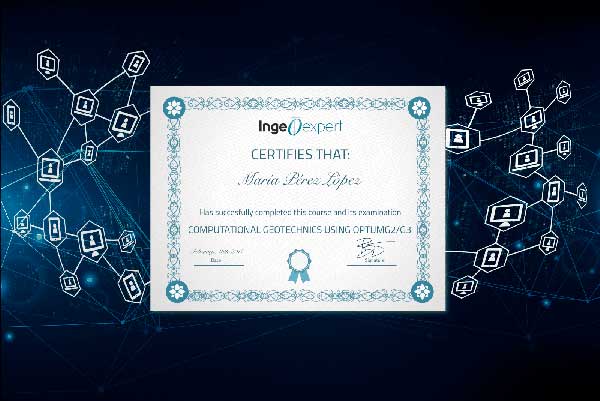
Blockchain technology makes the certificate incorruptible, enabling companies to verifiy its autenticity.
Reviews
There are no reviews yet.