
Pile foundations under earthquake loading using PLAXIS 3D
Online course |
|
50 hours / 6 weeks |
|
|
Dates: January 18th to March 1st |
| Standard | Unemployed Or Student |
| $383 | $313 |
In collaboration with Bentley Systems

PLAXIS 3D license included
Get an official certificate provided by Bentley Systems
Introduction
This course offers an advanced and comprehensive exploration of the seismic design and analysis of pile foundations.
Participants will develop the capability to conduct detailed earthquake analysis workflows, culminating in dynamic 3D modeling of pile foundations.
Using PLAXIS 3D software, combined with advanced constitutive models such as HSsmall and UBC3SAND, and supported by Python-based post-processing tools, this course bridges theoretical knowledge with real-world application.
Special emphasis is placed on understanding soil-structure interaction under dynamic loading, evaluating the effects of small-strain soil stiffness, liquefaction, and capturing pile performance in complex soil profiles.
By the end of the course, participants will be able to simulate seismic site conditions accurately, model the dynamic behavior of piles, extract critical design forces, and assess potential liquefaction impacts — equipping them to deliver seismic designs that meet the rigorous demands of modern geotechnical and engineering.
Preliminary Mini-Course (Included)
Before starting the main modules, participants will have access to two targeted preparatory mini-courses designed to ensure they can navigate PLAXIS 3D and leverage Python scripting effectively during the course:
A: PLAXIS 3D Practical Review Course
A practical hands-on review of PLAXIS 3D fundamentals:
- Soil mechanics principles embedded in geotechnical modeling.
- Setup and meshing of models.
- Applying boundary conditions, defining material properties.
- Running analyses and interpreting results efficiently.
Participants will gain solid confidence in building and interpreting geotechnical models in PLAXIS 3D.
This mini-course equips participants with powerful tools to streamline post-processing and ensure high-accuracy analysis in large dynamic models.
Limited places.
Module 1: PLAXIS 3D Practical Review Course
A practical hands-on review of PLAXIS 3D fundamentals:
- – Soil mechanics principles embedded in geotechnical modeling.
- – Setup and meshing of models.
- – Applying boundary conditions, defining material properties.
- – Running analyses and interpreting results efficiently.
Participants will gain solid confidence in building and interpreting geotechnical models in PLAXIS 3D.
Participants will gain solid confidence in building, running, and analyzing PLAXIS 3D models for a wide range of geotechnical problems.
Module 2: Constitutive Models for Dynamic Analysis – HSsmall and UBC3DSAND
This module introduces participants to advanced constitutive models used in dynamic soil–structure interaction analysis, focusing on how different formulations capture stiffness degradation, cyclic mobility, and liquefaction potential under seismic loading.
The module covers:
- – Limitations of Simple Elastic-Perfectly Plastic Models:
- Why conventional Mohr–Coulomb and linear-elastic models cannot reproduce stiffness reduction, hysteresis, or cyclic pore-pressure build-up.
- – The Hardening Soil Model (HS):
- Overview of the HS model and its stress-dependent stiffness formulation.
- Definition of hardening mechanisms and yield surfaces for primary loading and unloading.
- – The Hardening Soil Model with Small-Strain Stiffness (HSsmall):
- Key concepts: strain-dependent stiffness, hysteretic damping, and modulus degradation.
- Parameters governing HSsmall behavior (G₀, γ₀.₇, unloading/reloading stiffness).
- Cyclic behavior at small to medium strains and its implications for site response and foundation performance.
- – The UBC3DSAND Model:
- Background and purpose: capturing cyclic mobility and liquefaction of sands under earthquake loading.
- Core principles: effective stress formulation, strain-controlled dilatancy, and pore-pressure generation.
- Key parameters and their physical meaning (relative density, peak friction angle, contraction/dilatancy constants, modulus number, etc.).
- Calibration workflow using laboratory data or simplified empirical correlations.
- Comparison with HSsmall: when to use UBC3DSAND versus HSsmall for seismic soil–pile interaction
- – Dynamic Modelling Considerations:
- Energy dissipation in HSsmall (hysteretic) versus UBC3DSAND (pore-pressure driven).
- Supplementary Rayleigh damping at very small strains: guidelines and pitfalls.
By completing this module, participants will:
- Understand the theoretical and practical differences between HSsmall and UBC3DSAND models.
- Learn how to select, calibrate, and validate soil constitutive models for dynamic analyses.
- Be prepared to perform realistic pile foundation simulations capturing both cyclic degradation and excess-pore-pressure effects.
Module 3: Building and Running 3D Pile Models in PLAXIS 3D (Including Bridge Case Study)
In this module, participants will develop practical skills to build, simulate, and interpret 3D dynamic models of pile foundations subjected to seismic loading.
The module covers:
- – Setting Up the 3D Model in PLAXIS:
- Geometry definition for pile groups supporting a bridge structure.
- Soil stratigraphy representation based on site conditions.
- Mesh generation strategies for dynamic analysis.
- – Material Assignment:
- Use of HSsmall model for non-liquefiable soils.
- Preparation for dynamic soil-structure interaction.
- – Boundary Conditions and Initial Conditions:
- Application of appropriate lateral and bottom boundaries for dynamic runs.
- Initial stress generation for equilibrium before shaking phase.
- – Dynamic Loading Application:
- Applying the drift corrected earthquake acceleration/displacement time histories.
- Setting up time stepping, dynamic multipliers, and damping parameters.
- – Running the Dynamic Analysis:
- Key stability checks during the dynamic phase.
- Management of calculation steps to ensure accurate pile response.
This module prepares participants to execute full 3D dynamic simulations, capturing pile bending, displacement, and soil-pile interaction effects critical for seismic design verification.
Module 4: Liquefaction Analysis – Empirical Method and Finite Element Modelling with UBC3SAND
This module equips participants with techniques to assess the potential for soil liquefaction during seismic events, using both simplified empirical methods and advanced finite element modelling.
The module covers:
- – Empirical Liquefaction Assessment:
- Application of simplified liquefaction equivalent forces to the 3D FE model.
- – Finite Element Modelling for Liquefaction:
- Setting up soil profiles with liquefiable layers in PLAXIS 3D.
- Assigning UBC3SAND model properties to simulate pore pressure generation and strength loss.
- Dynamic loading application and observation of liquefaction triggering.
- – Post-Processing Liquefaction Effects:
- Monitoring excess pore water pressure ratios.
- Identifying liquefaction onset and lateral spreading effects on pile behavior.
By completing this module, participants will be able to conduct both quick screening assessments for liquefaction risk and more detailed, rigorous finite element simulations to capture soil behavior under cyclic loading.
Module 5: Python-Based Post-Processing – Part 1: Automated Extraction from PLAXIS 3D
This module introduces participants to the Python-PLAXIS interface and the automation of data extraction from PLAXIS 3D models.
It focuses on establishing a robust workflow for accessing, retrieving, and structuring numerical outputs efficiently.
The module covers:
- – Introduction to Python-PLAXIS API:
- Overview of the Python-PLAXIS scripting environment.
- Connection setup, authentication, and accessing model data programmatically.
- – Data Retrieval Fundamentals:
- Extracting key quantities such as bending moments, shear forces, and displacements along piles.
- Looping through calculation steps, nodes, and elements automatically.
- – Data Organization and Export:
- Structuring results for export into Excel or CSV format.
- Ensuring traceability and reproducibility in automated post-processing workflows.
By completing this module, participants will be able to build and execute Python scripts to extract pile forces and deformations from PLAXIS 3D models reliably and efficiently.
Module 6: Python-Based Post-Processing – Part 2: Interpretation and Visualization of Dynamic Results
This module builds upon the previous one, guiding participants through the interpretation, visualization, and engineering assessment of the extracted data.
It demonstrates how automated tools can turn large dynamic datasets into actionable design insights.
The module covers:
- – Post-Processing and Plotting Tools:
- Using supplied Python scripts and Excel templates to organize and visualize results.
- Connection setup, authentication, and accessing model data programmatically.
- – Dynamic Response Interpretation:
- Identifying peak bending moments, shear forces, and displacements.
- Recognizing the formation of critical sections and zones of potential failure.
- – Automation Advantages:
- Time savings and consistency in large-scale dynamic models.
- Reproducible and transparent analysis workflows for design documentation.
By completing this module, participants will be able to interpret and visualize dynamic pile responses confidently, producing professional-quality plots and summaries directly from PLAXIS 3D simulations.
Closing Summary
This course offers a fully integrated, real-world pathway for mastering the seismic analysis and design of pile foundations.
From understanding seismic hazard, generating realistic input motions, and performing nonlinear site response analysis, to building and running advanced 3D dynamic models, assessing liquefaction, and extracting critical results with Python — participants will gain both the theoretical knowledge and practical skills needed to deliver confident, high-quality seismic designs.
Through a bridge foundation case study and step-by-step modeling demonstrations, the course equips engineers to apply cutting-edge techniques immediately in their professional practice.
Participants will leave with a full workflow they can adapt to complex seismic projects in onshore, nearshore, or infrastructure settings, supported by a rich toolkit of assignments, templates, and automated scripts.
Mostafa Ismail
Mostafa Ismail is a Chartered Professional Engineer with over 25 years of geotechnical experience across academia and industry.
He has led high-profile infrastructure and offshore projects, specializing in advanced numerical modelling, pile foundation design, and seismic analysis. His expertise includes vibration analysis and the automation of geotechnical simulations using PLAXIS 2D/3D and Python.
As a Technical Executive at WSP, Mostafa oversees large-scale projects, applying innovative solutions to complex geotechnical challenges and delivering resilient, high-performance designs under demanding conditions. His contributions to major projects such as the South32 Boddington Bridge have been instrumental in advancing seismic design practice for critical infrastructure.
He has also led detailed debris flow assessments impacting offshore pipelines in the Philippines, demonstrating his wide-ranging geotechnical capability.
Throughout his career, Mostafa has worked across diverse environments, from onshore infrastructure to complex offshore developments. He previously served as the Australasia Numerical Lead with Arup in Perth before joining Advanced Geomechanics (now Fugro) in 2009.
Mostafa’s research contributions are internationally recognized. He has published extensively, served on the Editorial Board of the ASTM Geotechnical Testing Journal (GTJ), and was awarded the prestigious Hogentogler Award for the best paper in GTJ in 2006 during his tenure as an Associate Professor at the University of Western Australia.
In addition to his technical achievements, Mostafa is passionate about developing the next generation of engineers.
He regularly conducts internal training programs and has designed several online courses to share his knowledge globally.
As a numerical lead at WSP, he continually innovates, creating new solutions to meet the technical demands of the evolving geotechnical industry.
The course is delivered online through our easy-to-use Virtual Campus platform. For this course, a variety of content is provided including:
– eLearning materials
– Videos
– Interactive multimedia content
– Live webinar classes
– Texts and technical articles
– Case studies
– Assignments and evaluation exercises
Students can download the materials and work through the course at their own pace.
We regularly update this course to ensure the latest news and state-of-the-art developments are covered, and your knowledge of the subject is current.
Live webinars form part of our course delivery. These allow students and tutors to go through the course materials, exchange ideas and knowledge, and solve problems together in a virtual classroom setting. Students can also make use of the platform’s forum, a meeting point to interact with tutors and other students.
The tutoring system is managed by email. Students can email the tutor with any questions about the course and the tutor will be happy to help.
This course is particularly beneficial to:
- Geotechnical engineers, structural engineers, and infrastructure specialists involved in seismic design.
- Professionals engaged in the design and assessment of pile foundations subjected to earthquake loading.
- Engineers working on critical projects in seismic regions who seek to enhance their understanding of soil-structure interaction and advanced dynamic analysis methods.
The course is ideal for those aiming to strengthen their skills in practical earthquake engineering workflows, liquefaction assessment, and 3D dynamic modelling, and post-processing automation.
Previous knowledge.
Participants should have:
- A foundational understanding of geotechnical engineering principles and foundation design.
- Previous exposure to finite element analysis is beneficial, but not mandatory.
- Some basic experience with PLAXIS 3D will be helpful, although a full module reviewing the basics of 3D modelling is included.
Once a student finishes the course and successfully completes the assignments and evaluation tests, they are sent an accreditation certificate. The certificate is issued by Ingeoexpert to verify that the student has passed the course. It is a digital certificate that is unique and tamper-proof – it is protected by Blockchain technology. This means it is possible for anyone to check that it is an authentic, original document.
You will be able to download the certificate in an electronic format from the Virtual Campus platform. The certificate can be forwarded by email, shared on social networks, and embedded on websites. To see an example, click here.
Completing this course will enhance participants’ expertise in earthquake loading on pile foundations, opening up career opportunities in geotechnical and structural engineering roles, particularly in seismic design projects. This specialized knowledge is highly valued in infrastructure development, offshore and onshore construction, and consulting roles, providing a competitive edge in both private and public sector engineering positions.
In collaboration with Bentley Systems
PLAXIS 3D license included
Get an official certificate provided by Bentley Systems
Introduction
This course offers an advanced and comprehensive exploration of the seismic design and analysis of pile foundations.
Participants will develop the capability to conduct detailed earthquake analysis workflows, culminating in dynamic 3D modeling of pile foundations.
Using PLAXIS 3D software, combined with advanced constitutive models such as HSsmall and UBC3SAND, and supported by Python-based post-processing tools, this course bridges theoretical knowledge with real-world application.
Special emphasis is placed on understanding soil-structure interaction under dynamic loading, evaluating the effects of small-strain soil stiffness, liquefaction, and capturing pile performance in complex soil profiles.
By the end of the course, participants will be able to simulate seismic site conditions accurately, model the dynamic behavior of piles, extract critical design forces, and assess potential liquefaction impacts — equipping them to deliver seismic designs that meet the rigorous demands of modern geotechnical and engineering.
Preliminary Mini-Course (Included)
Before starting the main modules, participants will have access to two targeted preparatory mini-courses designed to ensure they can navigate PLAXIS 3D and leverage Python scripting effectively during the course:
A: PLAXIS 3D Practical Review Course
A practical hands-on review of PLAXIS 3D fundamentals:
- Soil mechanics principles embedded in geotechnical modeling.
- Setup and meshing of models.
- Applying boundary conditions, defining material properties.
- Running analyses and interpreting results efficiently.
Participants will gain solid confidence in building and interpreting geotechnical models in PLAXIS 3D.
This mini-course equips participants with powerful tools to streamline post-processing and ensure high-accuracy analysis in large dynamic models.
Limited places.
Module 1: PLAXIS 3D Practical Review Course
A practical hands-on review of PLAXIS 3D fundamentals:
- – Soil mechanics principles embedded in geotechnical modeling.
- – Setup and meshing of models.
- – Applying boundary conditions, defining material properties.
- – Running analyses and interpreting results efficiently.
Participants will gain solid confidence in building and interpreting geotechnical models in PLAXIS 3D.
Participants will gain solid confidence in building, running, and analyzing PLAXIS 3D models for a wide range of geotechnical problems.
Module 2: Constitutive Models for Dynamic Analysis – HSsmall and UBC3DSAND
This module introduces participants to advanced constitutive models used in dynamic soil–structure interaction analysis, focusing on how different formulations capture stiffness degradation, cyclic mobility, and liquefaction potential under seismic loading.
The module covers:
- – Limitations of Simple Elastic-Perfectly Plastic Models:
- Why conventional Mohr–Coulomb and linear-elastic models cannot reproduce stiffness reduction, hysteresis, or cyclic pore-pressure build-up.
- – The Hardening Soil Model (HS):
- Overview of the HS model and its stress-dependent stiffness formulation.
- Definition of hardening mechanisms and yield surfaces for primary loading and unloading.
- – The Hardening Soil Model with Small-Strain Stiffness (HSsmall):
- Key concepts: strain-dependent stiffness, hysteretic damping, and modulus degradation.
- Parameters governing HSsmall behavior (G₀, γ₀.₇, unloading/reloading stiffness).
- Cyclic behavior at small to medium strains and its implications for site response and foundation performance.
- – The UBC3DSAND Model:
- Background and purpose: capturing cyclic mobility and liquefaction of sands under earthquake loading.
- Core principles: effective stress formulation, strain-controlled dilatancy, and pore-pressure generation.
- Key parameters and their physical meaning (relative density, peak friction angle, contraction/dilatancy constants, modulus number, etc.).
- Calibration workflow using laboratory data or simplified empirical correlations.
- Comparison with HSsmall: when to use UBC3DSAND versus HSsmall for seismic soil–pile interaction
- – Dynamic Modelling Considerations:
- Energy dissipation in HSsmall (hysteretic) versus UBC3DSAND (pore-pressure driven).
- Supplementary Rayleigh damping at very small strains: guidelines and pitfalls.
By completing this module, participants will:
- Understand the theoretical and practical differences between HSsmall and UBC3DSAND models.
- Learn how to select, calibrate, and validate soil constitutive models for dynamic analyses.
- Be prepared to perform realistic pile foundation simulations capturing both cyclic degradation and excess-pore-pressure effects.
Module 3: Building and Running 3D Pile Models in PLAXIS 3D (Including Bridge Case Study)
In this module, participants will develop practical skills to build, simulate, and interpret 3D dynamic models of pile foundations subjected to seismic loading.
The module covers:
- – Setting Up the 3D Model in PLAXIS:
- Geometry definition for pile groups supporting a bridge structure.
- Soil stratigraphy representation based on site conditions.
- Mesh generation strategies for dynamic analysis.
- – Material Assignment:
- Use of HSsmall model for non-liquefiable soils.
- Preparation for dynamic soil-structure interaction.
- – Boundary Conditions and Initial Conditions:
- Application of appropriate lateral and bottom boundaries for dynamic runs.
- Initial stress generation for equilibrium before shaking phase.
- – Dynamic Loading Application:
- Applying the drift corrected earthquake acceleration/displacement time histories.
- Setting up time stepping, dynamic multipliers, and damping parameters.
- – Running the Dynamic Analysis:
- Key stability checks during the dynamic phase.
- Management of calculation steps to ensure accurate pile response.
This module prepares participants to execute full 3D dynamic simulations, capturing pile bending, displacement, and soil-pile interaction effects critical for seismic design verification.
Module 4: Liquefaction Analysis – Empirical Method and Finite Element Modelling with UBC3SAND
This module equips participants with techniques to assess the potential for soil liquefaction during seismic events, using both simplified empirical methods and advanced finite element modelling.
The module covers:
- – Empirical Liquefaction Assessment:
- Application of simplified liquefaction equivalent forces to the 3D FE model.
- – Finite Element Modelling for Liquefaction:
- Setting up soil profiles with liquefiable layers in PLAXIS 3D.
- Assigning UBC3SAND model properties to simulate pore pressure generation and strength loss.
- Dynamic loading application and observation of liquefaction triggering.
- – Post-Processing Liquefaction Effects:
- Monitoring excess pore water pressure ratios.
- Identifying liquefaction onset and lateral spreading effects on pile behavior.
By completing this module, participants will be able to conduct both quick screening assessments for liquefaction risk and more detailed, rigorous finite element simulations to capture soil behavior under cyclic loading.
Module 5: Python-Based Post-Processing – Part 1: Automated Extraction from PLAXIS 3D
This module introduces participants to the Python-PLAXIS interface and the automation of data extraction from PLAXIS 3D models.
It focuses on establishing a robust workflow for accessing, retrieving, and structuring numerical outputs efficiently.
The module covers:
- – Introduction to Python-PLAXIS API:
- Overview of the Python-PLAXIS scripting environment.
- Connection setup, authentication, and accessing model data programmatically.
- – Data Retrieval Fundamentals:
- Extracting key quantities such as bending moments, shear forces, and displacements along piles.
- Looping through calculation steps, nodes, and elements automatically.
- – Data Organization and Export:
- Structuring results for export into Excel or CSV format.
- Ensuring traceability and reproducibility in automated post-processing workflows.
By completing this module, participants will be able to build and execute Python scripts to extract pile forces and deformations from PLAXIS 3D models reliably and efficiently.
Module 6: Python-Based Post-Processing – Part 2: Interpretation and Visualization of Dynamic Results
This module builds upon the previous one, guiding participants through the interpretation, visualization, and engineering assessment of the extracted data.
It demonstrates how automated tools can turn large dynamic datasets into actionable design insights.
The module covers:
- – Post-Processing and Plotting Tools:
- Using supplied Python scripts and Excel templates to organize and visualize results.
- Connection setup, authentication, and accessing model data programmatically.
- – Dynamic Response Interpretation:
- Identifying peak bending moments, shear forces, and displacements.
- Recognizing the formation of critical sections and zones of potential failure.
- – Automation Advantages:
- Time savings and consistency in large-scale dynamic models.
- Reproducible and transparent analysis workflows for design documentation.
By completing this module, participants will be able to interpret and visualize dynamic pile responses confidently, producing professional-quality plots and summaries directly from PLAXIS 3D simulations.
Closing Summary
This course offers a fully integrated, real-world pathway for mastering the seismic analysis and design of pile foundations.
From understanding seismic hazard, generating realistic input motions, and performing nonlinear site response analysis, to building and running advanced 3D dynamic models, assessing liquefaction, and extracting critical results with Python — participants will gain both the theoretical knowledge and practical skills needed to deliver confident, high-quality seismic designs.
Through a bridge foundation case study and step-by-step modeling demonstrations, the course equips engineers to apply cutting-edge techniques immediately in their professional practice.
Participants will leave with a full workflow they can adapt to complex seismic projects in onshore, nearshore, or infrastructure settings, supported by a rich toolkit of assignments, templates, and automated scripts.
Mostafa Ismail
Mostafa Ismail is a Chartered Professional Engineer with over 25 years of geotechnical experience across academia and industry.
He has led high-profile infrastructure and offshore projects, specializing in advanced numerical modelling, pile foundation design, and seismic analysis. His expertise includes vibration analysis and the automation of geotechnical simulations using PLAXIS 2D/3D and Python.
As a Technical Executive at WSP, Mostafa oversees large-scale projects, applying innovative solutions to complex geotechnical challenges and delivering resilient, high-performance designs under demanding conditions. His contributions to major projects such as the South32 Boddington Bridge have been instrumental in advancing seismic design practice for critical infrastructure.
He has also led detailed debris flow assessments impacting offshore pipelines in the Philippines, demonstrating his wide-ranging geotechnical capability.
Throughout his career, Mostafa has worked across diverse environments, from onshore infrastructure to complex offshore developments. He previously served as the Australasia Numerical Lead with Arup in Perth before joining Advanced Geomechanics (now Fugro) in 2009.
Mostafa’s research contributions are internationally recognized. He has published extensively, served on the Editorial Board of the ASTM Geotechnical Testing Journal (GTJ), and was awarded the prestigious Hogentogler Award for the best paper in GTJ in 2006 during his tenure as an Associate Professor at the University of Western Australia.
In addition to his technical achievements, Mostafa is passionate about developing the next generation of engineers.
He regularly conducts internal training programs and has designed several online courses to share his knowledge globally.
As a numerical lead at WSP, he continually innovates, creating new solutions to meet the technical demands of the evolving geotechnical industry.
The course is delivered online through our easy-to-use Virtual Campus platform. For this course, a variety of content is provided including:
– eLearning materials
– Videos
– Interactive multimedia content
– Live webinar classes
– Texts and technical articles
– Case studies
– Assignments and evaluation exercises
Students can download the materials and work through the course at their own pace.
We regularly update this course to ensure the latest news and state-of-the-art developments are covered, and your knowledge of the subject is current.
Live webinars form part of our course delivery. These allow students and tutors to go through the course materials, exchange ideas and knowledge, and solve problems together in a virtual classroom setting. Students can also make use of the platform’s forum, a meeting point to interact with tutors and other students.
The tutoring system is managed by email. Students can email the tutor with any questions about the course and the tutor will be happy to help.
This course is particularly beneficial to:
- Geotechnical engineers, structural engineers, and infrastructure specialists involved in seismic design.
- Professionals engaged in the design and assessment of pile foundations subjected to earthquake loading.
- Engineers working on critical projects in seismic regions who seek to enhance their understanding of soil-structure interaction and advanced dynamic analysis methods.
The course is ideal for those aiming to strengthen their skills in practical earthquake engineering workflows, liquefaction assessment, and 3D dynamic modelling, and post-processing automation.
Previous knowledge.
Participants should have:
- A foundational understanding of geotechnical engineering principles and foundation design.
- Previous exposure to finite element analysis is beneficial, but not mandatory.
- Some basic experience with PLAXIS 3D will be helpful, although a full module reviewing the basics of 3D modelling is included.
Once a student finishes the course and successfully completes the assignments and evaluation tests, they are sent an accreditation certificate. The certificate is issued by Ingeoexpert to verify that the student has passed the course. It is a digital certificate that is unique and tamper-proof – it is protected by Blockchain technology. This means it is possible for anyone to check that it is an authentic, original document.
You will be able to download the certificate in an electronic format from the Virtual Campus platform. The certificate can be forwarded by email, shared on social networks, and embedded on websites. To see an example, click here.
Completing this course will enhance participants’ expertise in earthquake loading on pile foundations, opening up career opportunities in geotechnical and structural engineering roles, particularly in seismic design projects. This specialized knowledge is highly valued in infrastructure development, offshore and onshore construction, and consulting roles, providing a competitive edge in both private and public sector engineering positions.
More info
Finish this course and get a certificate based on Blockchain
Pile foundations under earthquake loading using PLAXIS 3D
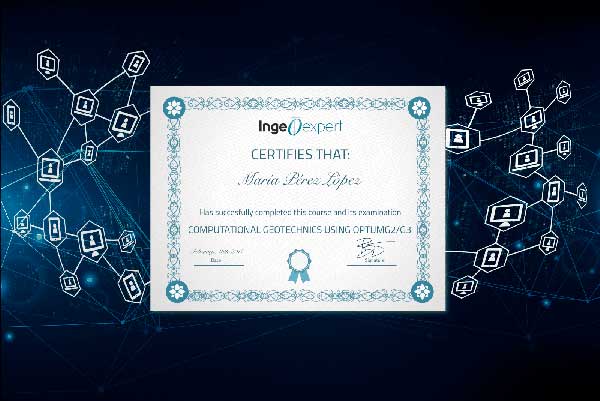
Blockchain technology makes the certificate incorruptible, enabling companies to verifiy its autenticity.
Pile foundations under earthquake loading using PLAXIS 3D
| $383 | $313 | |
| Get more information |
Reviews
There are no reviews yet.