
Practical Geotechnical Core Logging for Mining & Civil Engineering
40 hours / 6 weeks |
|
Online course |
|
|
Dates: January 25th to March 8th |
| Standard | Unemployed Or Student |
| $406 | $313 |
Introduction
Geotechnical core logging is an essential part of a ground investigation. A well-prepared core log provides a factual record of the rock material and discontinuities encountered in a borehole and creates a foundation for subsequent geological interpretation and engineering assessment.
Producing a reliable log involves more than describing what is visible in a core box. It requires an understanding of drilling runs, depth markers and core recovery; consistent description of rock material and discontinuities; careful review of strength-test evidence; and clear documentation of uncertainty, corrections and missing information.
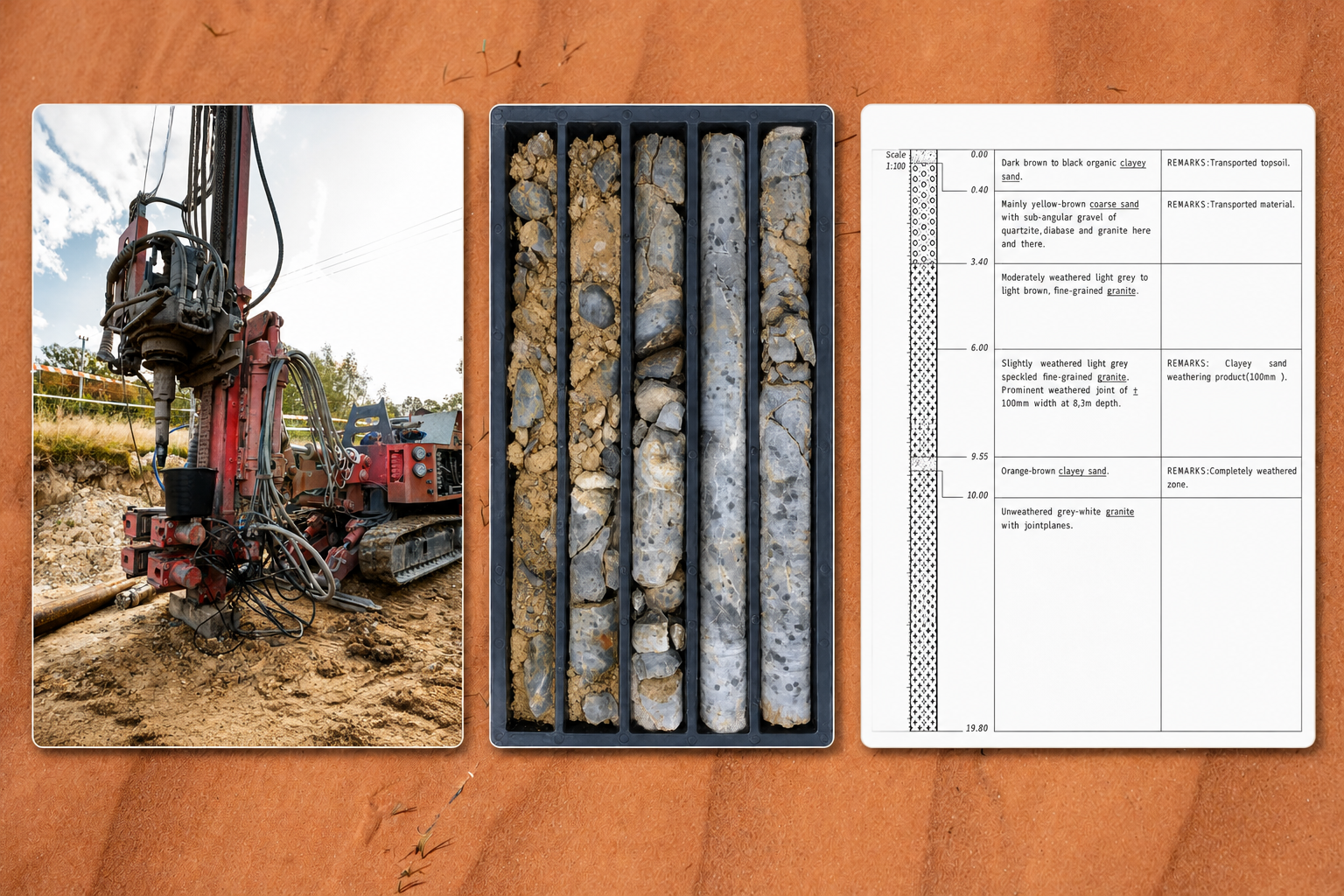
This practical course follows the logging process from the first inspection of recovered core through to the preparation and quality control of an integrated geotechnical log. Participants will work with synthetic core evidence, drilling records, diagrams, logging tools and practical exercises representative of the decisions encountered in mining and civil engineering investigations.
The course places particular emphasis on distinguishing observation, measurement, calculation and interpretation, and on maintaining traceability between core, samples, photographs, tests and final records.
Course objectives
By the end of the course, participants should be able to:
- Reconstruct core sequence, drilling-run boundaries and depth provenance from the available records.
- Calculate and qualify total core recovery, solid core recovery and Rock Quality Designation, and identify recovery discrepancies.
- Describe rock material, including texture, fabric, weathering, alteration and field-estimated strength.
- Assess evidence for natural and drilling-induced breaks and describe discontinuity characteristics.
- Review point-load test records and supporting strength-test evidence.
- Assess the reliability of oriented-core reference lines and the information needed for orientation inputs.
- Recognise discrepancies between physical core depths and digitally reconstructed core imagery.
- Assemble structured, traceable factual logging records.
- Document uncertainty, missing information and corrections.
- Independently review an integrated core log and identify unresolved issues before it is issued.
Duration and assessment
The course runs over six calendar weeks, including four instructional weeks and a further two-week period for completion of the final integrated assignment and feedback. The total estimated workload is approximately 40 hours, comprising structured learning, practical exercises, reading materials, and the final assignment. Assessment comprises four weekly graded practical assignments and one separate final integrated assignment. Materials are released progressively, allowing participants to organise their study within the published course schedule
Limited places.
Week 1 – Trust the recovered evidence
The first week establishes a reliable basis for logging by examining how core is recovered, handled, identified and linked to drilling-run records.
- – The purpose of geotechnical core logging.
- – Observation, measurement, interpretation, uncertainty and provenance.
- – Drilling runs, core boxes, depth blocks and the order of recovered core.
- – Core handling, mechanical breaks and sample removal.
- – Core photography and image identity.
- – Core loss, gain and recovery reconciliation.
- – Calculation and interpretation of Total Core Recovery (TCR).
Practical assignment: Reconstruction of a drilling run, core depth checks and TCR calculation.
Week 2 – Describe material and calculate qualified RQD
The second week develops factual rock-material descriptions and examines how break-origin decisions affect recovery and RQD records.
- – Lithology, colour, texture, fabric and contacts.
- – Weathering and alteration: description and distinction.
- – Field-estimated rock strength.
- – Evidence for natural and induced breaks.
- – Solid Core Recovery (SCR).
- – Rock Quality Designation (RQD) under declared project conventions.
- – Recording uncertainty and explaining qualified results.
Practical assignment: Rock-material logging, break-origin decisions and qualified SCR/RQD calculations.
Week 3 – Characterise defects and strength evidence
The third week focuses on the description of discontinuities and the review of field strength-test evidence.
- – Discontinuity description and apparent angle.
- – Frequency, roughness and waviness.
- – Infilling, coatings and wall conditions.
- – Limits on interpreting aperture, persistence and fault or shear features from core.
- – Point-load test records and test validity.
- – Point-load strength index, Is and Is(50).
- – Strength correlations and their limitations.
- – Schmidt rebound as supporting evidence.
Practical assignment: Discontinuity characterisation and review of a strength-test record.
Week 4 – Integrate and independently QA factual records
The final week brings the records together and develops a structured approach to checking the log before issue.
- – Oriented-core reference lines and confidence in their reliability.
- – Alpha/beta conventions and the need for local borehole trajectory information.
- – Core photography, digital imagery and reconstructed depths.
- – Physical versus digital depth discrepancies.
- – Structured data, codes, null states and linked records.
- – Documenting corrections and unresolved issues.
- – Factual reporting and independent pre-issue quality assurance.
Practical assignment: Targeted orientation, digital-depth and data-quality checks.
Final integrated assignment: Preparation and independent review of factual logging records using a fictional borehole evidence package.
Practical exercises and course materials
Practical work is integrated throughout the four weeks. Participants will work through weekly exercises and graded practical assignments before completing a separate final integrated assignment.
The planned course resources include:
- – A technical manual and field-guide reference material.
- – Teaching slides and visual examples.
- – Editable logging and checking tools.
- – Core logging, recovery/RQD, discontinuity and strength-test registers.
- – Photography and sample registers.
- – A quality-control checklist and worked example.
The materials are being finalised as part of the course production process.
Teaching approach
The course progresses from relatively clear evidence to more qualified and ambiguous observations, before combining them in an integrated logging and quality-control exercise.
Participants will practise documenting what the available evidence supports, identifying what remains uncertain and recognising when further information is needed. The course prepares participants to produce and review defensible factual records that can support subsequent engineering work.
Julien Roussel
Senior Engineering Geologist.
Julien is an engineering geologist with approximately 19 years of experience in engineering geology, geotechnical engineering and rock mechanics in France and internationally. His experience includes mining, tunnels and underground works, ground investigations, rock mass characterisation and geotechnical core logging.
The course is delivered online through our easy-to-use Virtual Campus platform. For this course, a variety of content is provided including:
– eLearning materials
– Videos
– Interactive multimedia content
– Live webinar classes
– Texts and technical articles
– Case studies
– Assignments and evaluation exercises
Students can download the materials and work through the course at their own pace.
We regularly update this course to ensure the latest news and state-of-the-art developments are covered, and your knowledge of the subject is current.
Live webinars form part of our course delivery. These allow students and tutors to go through the course materials, exchange ideas and knowledge, and solve problems together in a virtual classroom setting. Students can also make use of the platform’s forum, a meeting point to interact with tutors and other students.
The tutoring system is managed by email. Students can email the tutor with any questions about the course and the tutor will be happy to help.
The course is intended for:
- – Graduate engineering geologists and early-career geotechnical engineers.
- – Mine geologists and civil engineering geologists involved in ground investigations.
- – Drilling and core-shed personnel responsible for handling or recording core.
- – Students and practitioners seeking a structured introduction to geotechnical core logging.
- – Experienced professionals who would like to review their logging and quality-control practices.
The course is aimed at beginner-to-intermediate professional practice. Participants should be comfortable with basic geological terminology, depth and length measurements, simple percentage calculations, and working with PDF documents, images and simple spreadsheets. Previous professional logging experience is not mandatory.
Once a student finishes the course and successfully completes the assignments and evaluation tests, they are sent an accreditation certificate. The certificate is issued by Ingeoexpert to verify that the student has passed the course. It is a digital certificate that is unique and tamper-proof – it is protected by Blockchain technology. This means it is possible for anyone to check that it is an authentic, original document.
-
Engineering Geologist / Geotechnical Geologist: Factual core logging and rock characterisation for civil engineering and ground investigations.
-
Mine Geologist / Geotechnical Technician: Logging and geomechanical data collection for open-pit, underground, and exploration projects.
-
Field Geotechnical Engineer: On-site drilling supervision, depth reconciliation, and borehole QA/QC.
-
Core Shed Geologist / Supervisor: Core handling, photographic records, sampling, and recovery/RQD calculations.
-
Geotechnical Data & QA/QC Reviewer: Independent auditing, data validation, and pre-issue quality control of integrated core logs.
Key Sectors: Geotechnical & civil consultancies, mining companies, and ground investigation contractors.
More info
Finish this course and get a certificate based on Blockchain
Practical Geotechnical Core Logging for Mining & Civil Engineering

Blockchain technology makes the certificate incorruptible, enabling companies to verifiy its autenticity.
Practical Geotechnical Core Logging for Mining & Civil Engineering
| $406 | $313 | |
| Get more information |
Reviews
There are no reviews yet.