

Deep Foundations – Axial Analysis with RSPile Software: From Theory to Practice
Online course |
|
50 hours / 6 weeks |
|
|
Dates: September 21st to November 2nd |
| Standard | Unemployed Or Student |
| $371 | $325 |
Introduction
This is the only course that combines a deep theoretical foundation with hands-on, software-based design of axially loaded piles—giving you practical skills you can apply immediately in real-world projects. This is the most comprehensive course available on axial pile analysis—featuring around 100 instructional videos and 350 detailed slides, combining rigorous theory with practical software-based design using RS Pile.
“Axial Pile Analysis with RS Pile – From Theory to Practice” is the third course in our growing series titled “From Theory to Practice,” following Module (1): Bearing Resistance and Module (2): Settlement Analysis. Together, these courses form a comprehensive learning path for geotechnical engineers aiming to master core foundation design topics with real-world application and modern tools.
This course is designed to equip engineers with the theoretical foundations and practical tools needed to confidently analyze and design deep foundations under axial loading conditions. Pile foundations are a cornerstone of modern geotechnical design, especially when structures must be supported over weak, compressible, or variable subsurface conditions. Yet, despite their importance, axial pile analysis is often oversimplified in practice—leading to conservative, inefficient, or even unsafe foundation designs.
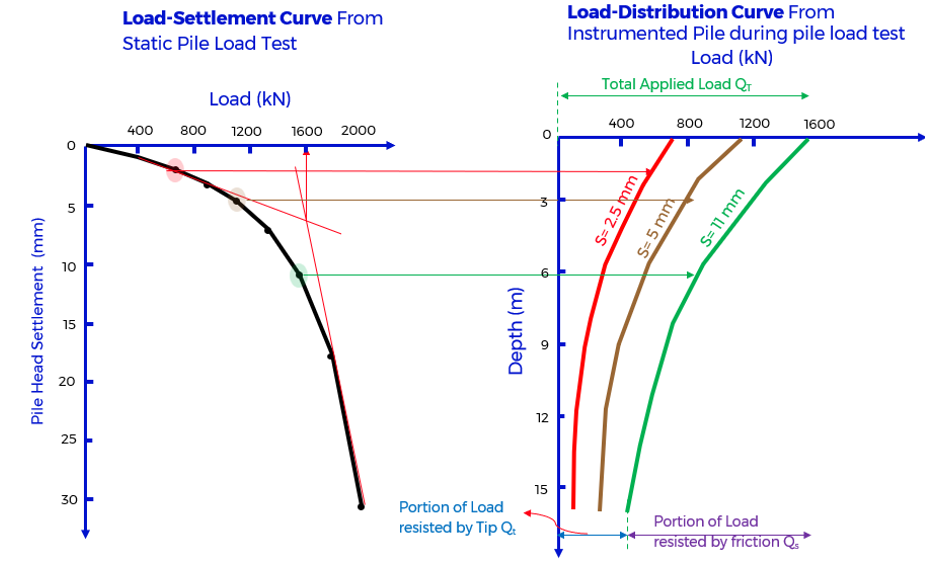
In this course, we address this gap head-on. Over six weeks, you will gain a solid understanding of axial pile behavior in both cohesive and cohesionless soils, covering essential concepts such as ultimate resistance, load transfer mechanisms, skin friction vs. end bearing, and pile group effects. The course integrates theory with detailed design workflows using RS Pile, Rocscience’s powerful pile analysis software. You’ll not only learn how to interpret and apply analytical methods, but also how to model and solve real-world design problems with RS Pile—from single piles to pile groups, and from serviceability checks to factored resistance design.
A key feature of this course is its practical focus: through numerous guided examples, you’ll explore how to align your geotechnical input with structural design demands, understand the importance of soil-structure interaction, and avoid common pitfalls such as relying on overly simplistic assumptions or misinterpreting pile load test results. We’ll also walk through the interpretation of software outputs, and how to calibrate models to reflect field conditions accurately.
Whether you’re a geotechnical engineer aiming to deepen your foundation design skills, a structural engineer seeking better collaboration with the geotechnical side, or a site or consulting professional dealing with pile-supported systems—this course will give you confidence and competence to handle axial pile analysis with clarity and precision.
Objectives
By the end of this course, you will be able to:
- Understand axial load transfer mechanisms in bored and driven piles, including shaft friction, toe resistance, and how they develop in different soil conditions.
- Design individual piles manually using established methods such as the α-method, β-method, and Nordlund method — with confidence in your assumptions, units, and geotechnical reasoning.
- Model piles in RS Pile and interpret load-settlement curves, failure mechanisms, and interaction effects between piles and soil.
- Evaluate pile behavior under compression and tension, considering real-world conditions like setup, downdrag, scour, and relaxation.
- Analyze group pile behavior, compute group efficiency, and apply the equivalent block and equivalent footing approaches in cohesive and cohesionless soils.
- Apply factored design approaches using current North American standards (CSA S6-19, AASHTO 2020, CFEM 2023), including consequence classification and resistance factors.
- Estimate settlement for both single piles and pile groups using empirical and elastic continuum methods — and determine tolerable limits based on structural input.
- Bridge the gap between structural and geotechnical design, understanding what information to exchange, how to model piles as springs, and how to communicate your recommendations clearly.
- Work with real field data from boreholes, SPT/CPT results, and lab tests — and use that data to make decisions that mirror industry practice.
- Deliver confident, defensible design recommendations that can stand up in meetings, reports, and technical reviews.
Limited places.
Module 1
- – Chapter 1. Introduction (5 Sections in 5 Videos)
- – Chapter 2. Individual Pile Ultimate Axial Compression Resistance (7 Sections + 4 RS Pile Examples = 24 Videos)
Module 2
- – Chapter 3. Individual Pile Ultimate Axial Compression Resistance (2 Sections + 2 RS Pile Examples = 6 Videos)
- – Chapter 4. Different Capacities for Driven Piles (5 Sections in 6 Videos+ 4 RS Pile Examples = 11 Videos)
Module 3
- – Chapter 5. Individual Pile Ultimate Axial Compression Resistance (2 Sections = 7 videos)
- – Chapter 6. Individual Pile Ultimate Axial Tension Resistance (2 Sections = 2 Videos)
- – Chapter 7. Pile Group Resistance (6 Sections + One RS Pile Example = 78 Videos)
Module 4
- – Chapter 8. Factored Axial Capacity (5 Sections = 5 Videos)
- – Chapter 9. Individual Pile Settlement – (Serviceability Limit State) (4 Sections = 4 Videos)
Module 5
- – Chapter 10. Axial Pile Analysis (10 Sections + 5 RS Pile Examples = 16 Videos)
Module 6
- – Chapter 11. Pile Group Settlement (4 Sections + One RS Pile Example = 5 Videos)
- – Chapter 12. Structure-Geotechnical Cycle (One Section = One Video)
- – Chapter 13. Topics we did not cover? (One Section = One Video)
Dr. Ahmed ElMouchi (PhD, PEng)
A Geotechnical Engineer Who Has Walked Your Path
This section is meant to show you how competent your professor is — so yes, you’ll see plenty of accomplishments here. But this course wasn’t built to impress; it was built to help.
I created this course because I was once exactly where you are — looking for clarity in a field full of complexity. I know the questions you’re asking, because I’ve asked them myself. And I promised myself that when I figured it out, I’d help others do the same.
This course took over a year to build — not because the content was hard to gather, but because I wanted to make sure it speaks to your level, your pace, and your goals. I hope you feel that in every chapter.
Your Instructor at a Glance
- – Senior Geotechnical Engineer, WSP Canada Inc.
- – Sessional Instructor, University of British Columbia (UBC) — ranked among the top 50 universities worldwide
- – 13+ Years of Experience in geotechnical engineering, including major projects across 3 continents
- – PhD in Geotechnical Engineering, UBC – Specialized in soil stabilization and soft ground behavior
- – 9 peer-reviewed papers on tunnel engineering, soft soils, and numerical modelling
- – Award-winning educator, trained in learning design and teaching methods
- – Fluent in advanced geotechnical software, including PLAXIS 2D/3D, RS Pile, Settle3, Slide2, and more
He has also led geotechnical design for public buildings, slope stabilization works, highway projects, and foundation systems under seismic and challenging soil conditions throughout Canada.
Not Just a Practitioner — A Dedicated Educator
As a sessional instructor at UBC, Dr. Elmouchi has taught multiple geotechnical engineering courses to undergraduate and graduate students, focusing on bridging the gap between academic theory and field practice. He is formally trained in learning design and curriculum development, ensuring that this course is:
- – Clear and digestible
- – Purposefully paced
- – Centered around practical outcomes
His teaching reflects the same attention to clarity and rigor that defines his consulting work.
Research-Driven. Practice-Proven.
During his PhD, Dr. Elmouchi managed the Geotechnical Materials Laboratory at UBC Okanagan, supervising graduate students and conducting advanced soil testing and analysis. His research — funded by NSERC — focused on the geotechnical behavior and stabilization of peaty soils, producing a widely respected body of work on compressibility and settlement control.
Recognitions and Professional Involvement
- – University Graduate Fellowship, UBC (2018, 2019, 2020)
- – NSERC PhD Scholarship Recipient (2018–2021)
- – Volunteer with Engineers & Geoscientists BC (EGBC)
- – Active member of VGS, CGS, and ISSMGE
- – P.Eng. designation in British Columbia, and working toward PE licensure in the U.S.
A Message From Dr. Elmouchi
“I’m not here to just teach you how to calculate resistance. I’m here to help you think like a designer — someone who understands the soil, not just the software. You’re building a skillset that the industry needs more than ever. I’m proud to help you build it.”
The course is delivered online through our easy-to-use Virtual Campus platform. For this course, a variety of content is provided including:
– eLearning materials
– Videos
– Interactive multimedia content
– Live webinar classes
– Texts and technical articles
– Case studies
– Assignments and evaluation exercises
We regularly update this course to ensure the latest news and state-of-the-art developments are covered, and your knowledge of the subject is current.
Live webinars form part of our course delivery. These allow students and tutors to go through the course materials, exchange ideas and knowledge, and solve problems together in a virtual classroom setting. Students can also make use of the platform’s forum, a meeting point to interact with tutors and other students.
The tutoring system is managed by email. Students can email the tutor with any questions about the course and the tutor will be happy to help.
- – Civil engineers looking to specialize in geotechnical aspects of construction projects.
- – Engineering students aspiring to build a career in geotechnical engineering.
- – Geotechnical engineers seeking to deepen their knowledge and practical skills in deep foundation design.
- – Geology graduates who are involved in geotechnical engineering work and would like to learn about geotechnical engineering.
- – Site geotechnical engineers who are willing to move and expand their horizons in geotechnical engineering design.
- – Practicing professionals aiming to stay updated with the latest industry standards and methodologies.
- – Consultants and contractors involved in foundation design and construction.
Once a student finishes the course and successfully completes the assignments and evaluation tests, they are sent an accreditation certificate. The certificate is issued by Ingeoexpert to verify that the student has passed the course. It is a digital certificate that is unique and tamper-proof – it is protected by Blockchain technology. This means it is possible for anyone to check that it is an authentic, original document.
You will be able to download the certificate in an electronic format from the Virtual Campus platform. The certificate can be forwarded by email, shared on social networks, and embedded on websites. To see an example, click here.
Completing “Axial Pile Analysis with RS Pile – From Theory to Practice” will significantly enhance your professional value and open new career opportunities in geotechnical and structural engineering. With a strong focus on both theoretical knowledge and applied design using industry-standard software, this course will prepare you for roles that demand confident decision-making in deep foundation design.
By completing this course, you will be able to:
- – Take full ownership of axial pile design in consulting, construction, or multidisciplinary engineering environments.
- – Collaborate more effectively with structural engineers by providing clear, design-ready geotechnical input based on realistic load-transfer mechanisms and software-backed evidence.
- – Move into more senior roles, such as senior geotechnical engineer or foundation design lead, by demonstrating your command of both the theory and the tools used in modern deep foundation practice.
- – Work more efficiently with software like RS Pile, giving you a competitive edge when applying for positions in firms that value advanced modeling capabilities.
- – Broaden your service offerings as a consultant by including detailed pile design, group analysis, and load-transfer modeling in your project scope.
- – Support quality assurance and field performance evaluations by understanding how to interpret pile load tests and correlate them to design assumptions.
Introduction
This is the only course that combines a deep theoretical foundation with hands-on, software-based design of axially loaded piles—giving you practical skills you can apply immediately in real-world projects. This is the most comprehensive course available on axial pile analysis—featuring around 100 instructional videos and 350 detailed slides, combining rigorous theory with practical software-based design using RS Pile.
“Axial Pile Analysis with RS Pile – From Theory to Practice” is the third course in our growing series titled “From Theory to Practice,” following Module (1): Bearing Resistance and Module (2): Settlement Analysis. Together, these courses form a comprehensive learning path for geotechnical engineers aiming to master core foundation design topics with real-world application and modern tools.
This course is designed to equip engineers with the theoretical foundations and practical tools needed to confidently analyze and design deep foundations under axial loading conditions. Pile foundations are a cornerstone of modern geotechnical design, especially when structures must be supported over weak, compressible, or variable subsurface conditions. Yet, despite their importance, axial pile analysis is often oversimplified in practice—leading to conservative, inefficient, or even unsafe foundation designs.
In this course, we address this gap head-on. Over six weeks, you will gain a solid understanding of axial pile behavior in both cohesive and cohesionless soils, covering essential concepts such as ultimate resistance, load transfer mechanisms, skin friction vs. end bearing, and pile group effects. The course integrates theory with detailed design workflows using RS Pile, Rocscience’s powerful pile analysis software. You’ll not only learn how to interpret and apply analytical methods, but also how to model and solve real-world design problems with RS Pile—from single piles to pile groups, and from serviceability checks to factored resistance design.
A key feature of this course is its practical focus: through numerous guided examples, you’ll explore how to align your geotechnical input with structural design demands, understand the importance of soil-structure interaction, and avoid common pitfalls such as relying on overly simplistic assumptions or misinterpreting pile load test results. We’ll also walk through the interpretation of software outputs, and how to calibrate models to reflect field conditions accurately.
Whether you’re a geotechnical engineer aiming to deepen your foundation design skills, a structural engineer seeking better collaboration with the geotechnical side, or a site or consulting professional dealing with pile-supported systems—this course will give you confidence and competence to handle axial pile analysis with clarity and precision.
Objectives
By the end of this course, you will be able to:
- Understand axial load transfer mechanisms in bored and driven piles, including shaft friction, toe resistance, and how they develop in different soil conditions.
- Design individual piles manually using established methods such as the α-method, β-method, and Nordlund method — with confidence in your assumptions, units, and geotechnical reasoning.
- Model piles in RS Pile and interpret load-settlement curves, failure mechanisms, and interaction effects between piles and soil.
- Evaluate pile behavior under compression and tension, considering real-world conditions like setup, downdrag, scour, and relaxation.
- Analyze group pile behavior, compute group efficiency, and apply the equivalent block and equivalent footing approaches in cohesive and cohesionless soils.
- Apply factored design approaches using current North American standards (CSA S6-19, AASHTO 2020, CFEM 2023), including consequence classification and resistance factors.
- Estimate settlement for both single piles and pile groups using empirical and elastic continuum methods — and determine tolerable limits based on structural input.
- Bridge the gap between structural and geotechnical design, understanding what information to exchange, how to model piles as springs, and how to communicate your recommendations clearly.
- Work with real field data from boreholes, SPT/CPT results, and lab tests — and use that data to make decisions that mirror industry practice.
- Deliver confident, defensible design recommendations that can stand up in meetings, reports, and technical reviews.
Limited places.
Module 1
- – Chapter 1. Introduction (5 Sections in 5 Videos)
- – Chapter 2. Individual Pile Ultimate Axial Compression Resistance (7 Sections + 4 RS Pile Examples = 24 Videos)
Module 2
- – Chapter 3. Individual Pile Ultimate Axial Compression Resistance (2 Sections + 2 RS Pile Examples = 6 Videos)
- – Chapter 4. Different Capacities for Driven Piles (5 Sections in 6 Videos+ 4 RS Pile Examples = 11 Videos)
Module 3
- – Chapter 5. Individual Pile Ultimate Axial Compression Resistance (2 Sections = 7 videos)
- – Chapter 6. Individual Pile Ultimate Axial Tension Resistance (2 Sections = 2 Videos)
- – Chapter 7. Pile Group Resistance (6 Sections + One RS Pile Example = 78 Videos)
Module 4
- – Chapter 8. Factored Axial Capacity (5 Sections = 5 Videos)
- – Chapter 9. Individual Pile Settlement – (Serviceability Limit State) (4 Sections = 4 Videos)
Module 5
- – Chapter 10. Axial Pile Analysis (10 Sections + 5 RS Pile Examples = 16 Videos)
Module 6
- – Chapter 11. Pile Group Settlement (4 Sections + One RS Pile Example = 5 Videos)
- – Chapter 12. Structure-Geotechnical Cycle (One Section = One Video)
- – Chapter 13. Topics we did not cover? (One Section = One Video)
Dr. Ahmed ElMouchi (PhD, PEng)
A Geotechnical Engineer Who Has Walked Your Path
This section is meant to show you how competent your professor is — so yes, you’ll see plenty of accomplishments here. But this course wasn’t built to impress; it was built to help.
I created this course because I was once exactly where you are — looking for clarity in a field full of complexity. I know the questions you’re asking, because I’ve asked them myself. And I promised myself that when I figured it out, I’d help others do the same.
This course took over a year to build — not because the content was hard to gather, but because I wanted to make sure it speaks to your level, your pace, and your goals. I hope you feel that in every chapter.
Your Instructor at a Glance
- – Senior Geotechnical Engineer, WSP Canada Inc.
- – Sessional Instructor, University of British Columbia (UBC) — ranked among the top 50 universities worldwide
- – 13+ Years of Experience in geotechnical engineering, including major projects across 3 continents
- – PhD in Geotechnical Engineering, UBC – Specialized in soil stabilization and soft ground behavior
- – 9 peer-reviewed papers on tunnel engineering, soft soils, and numerical modelling
- – Award-winning educator, trained in learning design and teaching methods
- – Fluent in advanced geotechnical software, including PLAXIS 2D/3D, RS Pile, Settle3, Slide2, and more
He has also led geotechnical design for public buildings, slope stabilization works, highway projects, and foundation systems under seismic and challenging soil conditions throughout Canada.
Not Just a Practitioner — A Dedicated Educator
As a sessional instructor at UBC, Dr. Elmouchi has taught multiple geotechnical engineering courses to undergraduate and graduate students, focusing on bridging the gap between academic theory and field practice. He is formally trained in learning design and curriculum development, ensuring that this course is:
- – Clear and digestible
- – Purposefully paced
- – Centered around practical outcomes
His teaching reflects the same attention to clarity and rigor that defines his consulting work.
Research-Driven. Practice-Proven.
During his PhD, Dr. Elmouchi managed the Geotechnical Materials Laboratory at UBC Okanagan, supervising graduate students and conducting advanced soil testing and analysis. His research — funded by NSERC — focused on the geotechnical behavior and stabilization of peaty soils, producing a widely respected body of work on compressibility and settlement control.
Recognitions and Professional Involvement
- – University Graduate Fellowship, UBC (2018, 2019, 2020)
- – NSERC PhD Scholarship Recipient (2018–2021)
- – Volunteer with Engineers & Geoscientists BC (EGBC)
- – Active member of VGS, CGS, and ISSMGE
- – P.Eng. designation in British Columbia, and working toward PE licensure in the U.S.
A Message From Dr. Elmouchi
“I’m not here to just teach you how to calculate resistance. I’m here to help you think like a designer — someone who understands the soil, not just the software. You’re building a skillset that the industry needs more than ever. I’m proud to help you build it.”
The course is delivered online through our easy-to-use Virtual Campus platform. For this course, a variety of content is provided including:
– eLearning materials
– Videos
– Interactive multimedia content
– Live webinar classes
– Texts and technical articles
– Case studies
– Assignments and evaluation exercises
We regularly update this course to ensure the latest news and state-of-the-art developments are covered, and your knowledge of the subject is current.
Live webinars form part of our course delivery. These allow students and tutors to go through the course materials, exchange ideas and knowledge, and solve problems together in a virtual classroom setting. Students can also make use of the platform’s forum, a meeting point to interact with tutors and other students.
The tutoring system is managed by email. Students can email the tutor with any questions about the course and the tutor will be happy to help.
- – Civil engineers looking to specialize in geotechnical aspects of construction projects.
- – Engineering students aspiring to build a career in geotechnical engineering.
- – Geotechnical engineers seeking to deepen their knowledge and practical skills in deep foundation design.
- – Geology graduates who are involved in geotechnical engineering work and would like to learn about geotechnical engineering.
- – Site geotechnical engineers who are willing to move and expand their horizons in geotechnical engineering design.
- – Practicing professionals aiming to stay updated with the latest industry standards and methodologies.
- – Consultants and contractors involved in foundation design and construction.
Once a student finishes the course and successfully completes the assignments and evaluation tests, they are sent an accreditation certificate. The certificate is issued by Ingeoexpert to verify that the student has passed the course. It is a digital certificate that is unique and tamper-proof – it is protected by Blockchain technology. This means it is possible for anyone to check that it is an authentic, original document.
You will be able to download the certificate in an electronic format from the Virtual Campus platform. The certificate can be forwarded by email, shared on social networks, and embedded on websites. To see an example, click here.
Completing “Axial Pile Analysis with RS Pile – From Theory to Practice” will significantly enhance your professional value and open new career opportunities in geotechnical and structural engineering. With a strong focus on both theoretical knowledge and applied design using industry-standard software, this course will prepare you for roles that demand confident decision-making in deep foundation design.
By completing this course, you will be able to:
- – Take full ownership of axial pile design in consulting, construction, or multidisciplinary engineering environments.
- – Collaborate more effectively with structural engineers by providing clear, design-ready geotechnical input based on realistic load-transfer mechanisms and software-backed evidence.
- – Move into more senior roles, such as senior geotechnical engineer or foundation design lead, by demonstrating your command of both the theory and the tools used in modern deep foundation practice.
- – Work more efficiently with software like RS Pile, giving you a competitive edge when applying for positions in firms that value advanced modeling capabilities.
- – Broaden your service offerings as a consultant by including detailed pile design, group analysis, and load-transfer modeling in your project scope.
- – Support quality assurance and field performance evaluations by understanding how to interpret pile load tests and correlate them to design assumptions.
More info
Finish this course and get a certificate based on Blockchain
Deep Foundations – Axial Analysis with RSPile Software: From Theory to Practice

Blockchain technology makes the certificate incorruptible, enabling companies to verifiy its autenticity.
Deep Foundations – Axial Analysis with RSPile Software: From Theory to Practice
| $371 | $325 | |
| Get more information |
Reviews
There are no reviews yet.